AGENART
Pieza del mes: marzo 2025
Autora: Tanya J. Tiffany
Cómo citar este artículo/How to cite this article: Tanya J. Tiffany, “The Infanta in the Louvre,” Agenart: La agencia artística de las mujeres de la Casa de Austria, 1532-1700, 07 de marzo de 2025. Consultado: 28 de julio de 2026. URL: https://agenart.org/the-infanta-in-the-louvre/
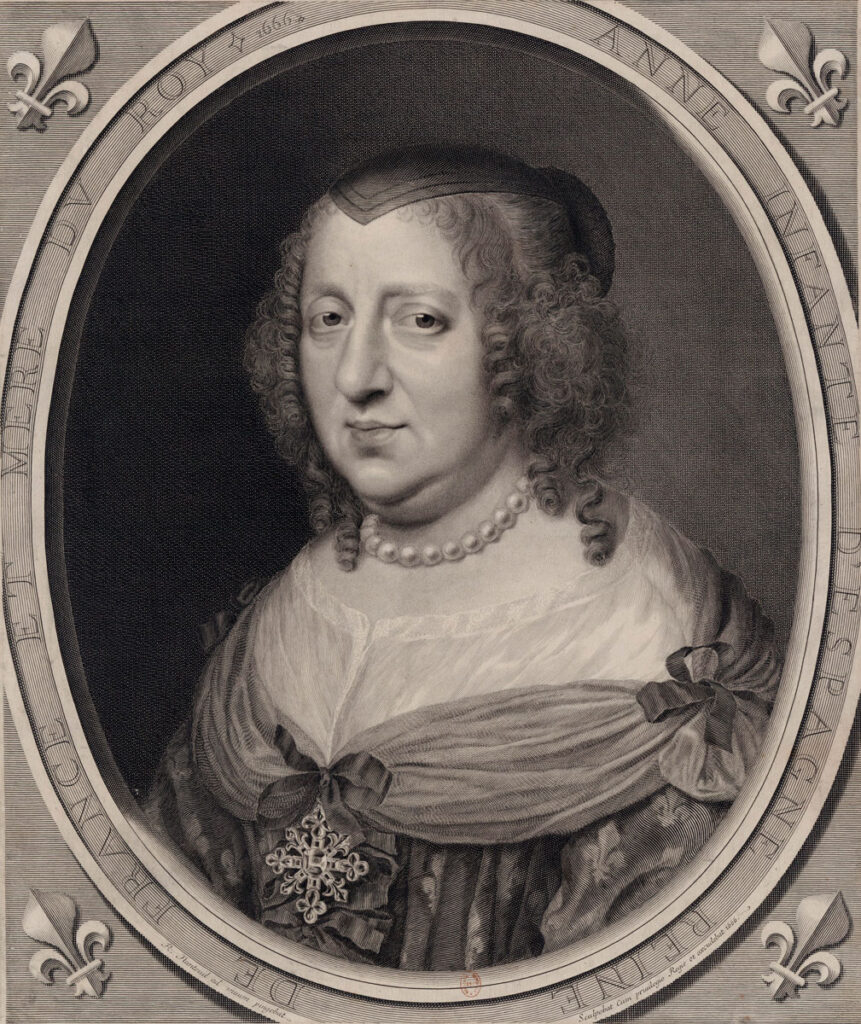
In March of 1654, Anne of Austria (Figure 1; Valladolid, 1601-Paris, 1666), the queen mother of France, requested a series of fifteen portraits of family members from the Spain of her birth. Because of the ongoing war between her native and adoptive lands, the queen needed to acquire the pictures through a series of diplomatic go-betweens. She reached out not to her relatives at the Spanish court, but rather to the Venetian ambassador in Paris. He, in turn, entrusted the commission to his counterpart in Madrid, who had the paintings shipped in October of that same year. Anne displayed the pictures in a small room inside her apartments in the Palais du Louvre. There, members of the Spanish House of Austria—including Anne’s brother Philip IV (1605-1665), his consorts, Isabel de Borbón (1603-1644; the daughter of a French king) and Mariana de Austria (1634-1696), and their children, Baltasar Carlos (1629-1646), María Teresa (1638-1683), and Margarita (1651-1673)—appeared in painted effigy. Their likenesses were seen in concert with portraits of Anne’s late husband, Louis XIII (1601-1643), and her son, Louis XIV (1638-1715), who would marry the infanta María Teresa in 1660, after the Peace of the Pyrenees marked the end of the Franco-Spanish conflict. With these pictures, the queen mother thus paid tribute to the dynasties of her birth and of her marriage and emphasized the interconnections between them.
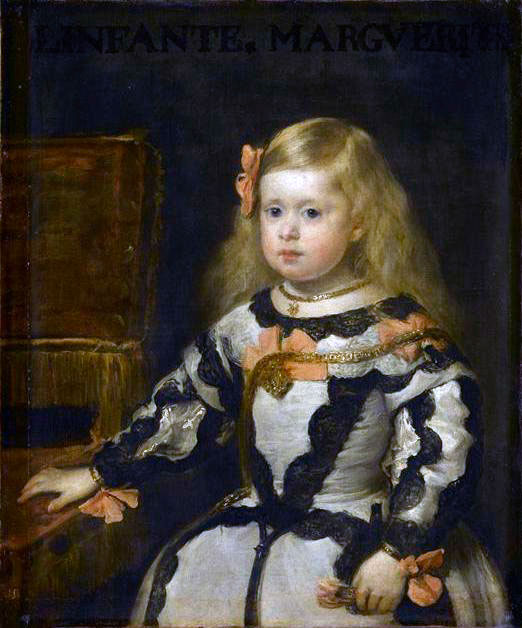
Most of the works from Anne of Austria’s 1654 commission have been lost or were sold, despite their poor condition, during the French Revolution, but one remains in the Louvre: the Portrait of the Infanta Margarita (Figure 2). The picture shows the child, in just over half length, wearing a white gown trimmed with pink bows and black lace, her right hand resting on a crimson velvet chair. Although nineteenth-century connoisseurs hailed the painting as a masterpiece by Diego Velázquez, scholars now agree that its technique points to the authorship of Juan Bautista Martínez del Mazo or another of Velázquez’s studio assistants. Unlike the portrait’s attribution, however, its provenance has never been disputed. The painting is documented continuously from the seventeenth century, and the canvas itself bears traces of its origins in the Louvre apartments. Like other works from the queen mother’s portrait gallery, it long bore an identifying inscription (probably added in the eighteenth century and removed during restoration in 1960), the vestiges of which —LINFANTE MARGVERITE— remain visible at the top of the composition.

Documents indicate that the Louvre painting was executed no more than a few months after Velázquez’s dazzling Infanta Margarita in Pink (Figure 3) now in the Kunsthistorisches Museum in Vienna. That painting shows the infanta in full length, standing upon a patterned carpet, her shimmering dress set off by the lush green of the curtain behind and of the table at her side, where her hand rests next to a vase containing daisies (margaritas in Spanish), her namesake flower. Although the Paris and Vienna paintings differ in format, they both depict a radiant, rosy-faced Margarita, who turns in three-quarter view and gazes with wide blue eyes at the viewer. Véronique Gerard-Powell has suggested that the two paintings were based on the same prototype: perhaps a bust-length portrait that Velázquez, in keeping with standard practice, painted from life and then employed in his studio as a model for subsequent likenesses, altering the backgrounds, costumes, and other details. This practice was convenient for early modern artists and their sitters, who routinely complained of the physical discomfort required to pose for pictures, and it was especially important in producing likenesses of children unable to keep from squirming under the artist’s watchful eye.
Margarita’s maternal grandfather, Holy Roman Emperor Ferdinand III, emphasized the difficulty of persuading children to sit for portraits in letters to Philip IV. In a missive from the spring of 1652, Ferdinand begged for a portrait of his new baby granddaughter (born July 12, 1651), but he was still waiting in late January of 1654, when he reminded the king of his desire. Affecting forbearance, the emperor acknowledged his need to “wait for the portrait of my granddaughter until it is convenient, because with little ones it is important to let them do as they please” (El retrato de mi nieta aguardare a su comodo, porque a las criaturas es menester dexallos a su gusto).[i] Ferdinand followed up in early March (the same month Anne of Austria requested her fifteen portraits), again recognizing that he would need to remain patient until “my granddaughter … is willing to have her portrait done” (El retrato de mi nieta aguardiere a su comodo y quando ella querrá dexarse retratar). Margarita must have finally proven amenable in the next months, because her likenesses were soon dispatched to Vienna and Paris. On October 8, having received his portrait, the emperor joyfully assured Philip IV that the result (Figure 3) had been worth the delay: “I have been delighted with the portrait of my granddaughter, who is most beautiful, may God keep her” (me [he] holgado mucho con el retrato de my nieta, que dios la guarde es lindisma).
Given that the Vienna and Paris portraits were both painted in the spring or summer of 1654, it is striking that the infanta appears so much younger in the Infanta in Pink than in the Louvre picture. The Infanta in Pink captures the tender, babylike plumpness of Margarita’s cheeks, the delicacy of her faint eyebrows, and the short, silky hair of a blonde toddler. Velázquez showed her dressed in a “little sack” and a skirt of types worn by both girls and boys in their first years of life, albeit embellished here with feminine flourishes.[ii] In the Infanta in Pink, her adornments—the regal gold chains across her torso and on her neck and wrists as well as the child’s protective charm on her shoulder (elements repeated in the Louvre picture)—emphasize the delicacy of her toddler’s frame, with its sloping shoulders, pudgy arms, and tiny hands.

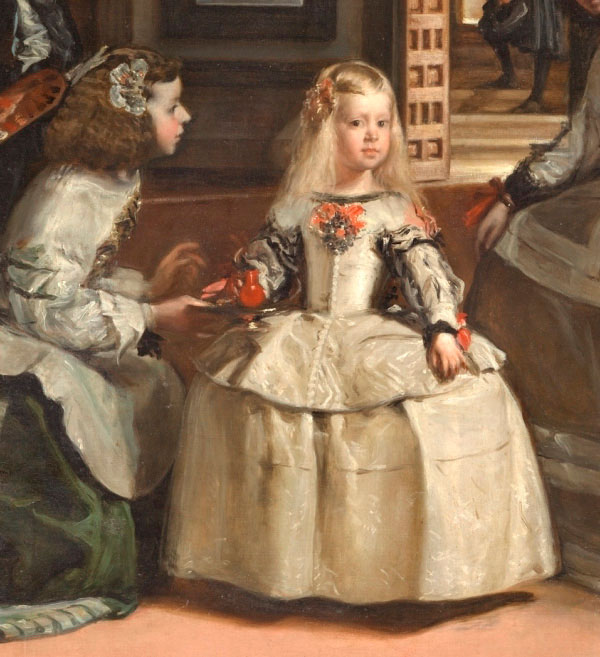
The Louvre painting (Figure 2) seems to portray Margarita as if she were a year or two older. Her face has the same shape and expression, but the artist more clearly defined her jawline and brow and gave her long, if still wispy, locks that cascade past her shoulders. She wears a dress with a feminine, scooped neckline and a well-defined bodice, whose close fit is accentuated by the black lace. Most notably, the infanta’s gown protrudes at the hips in a manner suggestive of the guardainfante (a type of farthingale): a garment popularized in large part by her mother, Queen Mariana, and one that alarmed moralists in part because it flaunted the female form. When the Louvre and Vienna pictures were painted in 1654, Margarita was not yet wearing the guardainfante; but, as Amanda Wunder has emphasized, she would begin to so in early 1656, when, although she was not quite five-years-old, her change in attire marked her transition to a more mature state of development. The dress in the Louvre picture seems to hint at the clothing that Margarita would soon adopt in imitation of her mother and other court women. With its hips broadened just slightly, the Louvre dress is not the child’s garment of the Infanta in Pink, but nor does it include the full, rigid and wide guardainfante she would don in 1656, as immortalized in the Infanta Margarita in White (also painted for shipment to Vienna) and Las Meninas (Figures 4–5).
Margarita’s apparent age in the Vienna and Paris pictures would have informed the reception of both portraits by her royal family members in central Europe and in France. While viewing the toddler shown in the Infanta in Pink, Emperor Ferdinand may have imagined himself to glimpse the child she had been in the two years before her likeness reached Vienna. The emperor surely also understood that the Infanta in Pink would be only the first of multiple portraits that he and his family would receive of Margarita; the composition would thus function as a point of departure from which they could observe the infanta’s growth. Beginning with the picture of 1654, the Spanish monarchs did indeed send portraits of the infanta at fairly regular intervals to the imperial court, and these works acquired particular importance after her betrothal to Ferdinand’s son, Emperor Leopold I, whom she married in 1666. By contrast, Anne of Austria could hardly expect routinely updated likenesses of Margarita or her other Spanish relatives while France and Spain remained at war. For the queen mother, the Louvre painting served not merely as a record of the infanta’s appearance at a particular moment, but as a more enduring image that showed Margarita as a child at the same time that it evoked the woman she was expected to become.
Selected bibliography:
- Baticle, Jeannine. “Recherches sur la connaissance de Velázquez en France de 1650 à 1830.” In Varia Velazqueña; homenaje a Velázquez en el III centenario de su muerte, 1660-1960, edited by Antonio Gallego y Burín, 1:532–52. Madrid: Dirección General de Bellas Artes, 1960.
- Cherry, Peter. “Velázquez and the Making of Queen Mariana de Austria.” Libros de la Corte, no. 28 (2024): 430–66.
- Cobo Delgado, Gemma. “Entre Viena y Madrid: intercambios de retratos en la familia Habsburgo durante el siglo XVII.” BSAA Arte 82 (2016): 143–66.
- de Carlos Varona, María Cruz. “Representando a la reina: la imagen de las Habsburgo españolas en su contexto europeo.” Libros de la Corte, no. 28 (2024): 269–76.
- Gerard-Powell, Véronique. “Portrait de l’infante Marguerite (Madrid, 1651-Vienne, 1673).” In Écoles espagnole et portugaise, by Véronique Gerard-Powell and Claudie Ressort, 247–51. Catalogue (Musée du Louvre. Département des peintures). Paris: Réunion des musées nationaux, 2002.
- Llorente, Mercedes. “Portraits of Children at the Spanish Court in the Seventeenth Century: The Infanta Margarita and the Young King Carlos II.” Bulletin for Spanish and Portuguese Historical Studies 35, no. 1 (2020): 30–47.
- Morán Turina, José Miguel, and Karl F. Rudolf. “Nuevos documentos en torno a Velázquez y a las colecciones reales.” Archivo español de arte 65, no. 259 (1992): 289–302.
- Oliván Santaliestra, Laura. “‘My Sister Is Growing up Very Healthy and Beautiful, She Loves Me’: The Chilhood of the Infantas María Teresa y Margarita María at Court.” In The Formation of the Child in Early Modern Spain, edited by Grace E. Coolidge, 165–88. London and New York: Routledge, 2014.
- Sommer-Mathis, Andrea. “Dynastic and Cultural Relations between the Two Lines of the Habsburg Dynasty and Their Effects on Velázquez’s Work.” In Velazquez: Las Meninas and the Late Royal Portraits, edited by Javier Portús Pérez, 61–74. Exh. cat., Madrid: Museo Nacional del Prado, 2013.
- Wunder, Amanda. Spanish Fashion in the Age of Velázquez: A Tailor at the Court of Philip IV. New Haven: Yale University Press, 2024.
- ———. “Women’s Fashions and Politics in Seventeenth-Century Spain: The Rise and Fall of the Guardainfante.” Renaissance Quarterly 68, no. 1 (April 2015): 133–86.
Captions to works referred to in the text:
- Figure 1. Robert Nanteuil, Portrait of Anne of Austria, 1666. Engraving. Paris, Bibliothèque nationale de France. Photo: https://commons.wikimedia.org/wiki/File:Anne_of_Austria_Queen_of_France_by_Robert_Nanteuil.jpeg
- Figure 2. Workshop of Diego Velázquez, Portrait of the Infanta Margarita, 1654. Oil on canvas. Paris, Musée du Louvre. Photo: https://upload.wikimedia.org/wikipedia/commons/d/da/Diego_Vel%C3%A1zquez_029.jpg
- Figure 3. Diego Velázquez, Infanta Margarita in Pink, 1654. Vienna, Kunsthistorisches Museum. Photo: https://en.wikipedia.org/wiki/Infanta_Margarita_Teresa_in_a_Peach_Dress
- Figure 4. Diego Velázquez, Infanta Margarita in White, ca. 1656. Vienna, Kunsthistorisches Museum. Photo: https://en.wikipedia.org/wiki/Infanta_Margarita_in_a_White_and_Silver_Dress
- Figure 5. Diego Velázquez, detail of Las Meninas, 1656. Madrid, Museo Nacional del Prado. Photo: © Museo Nacional del Prado.


[i] For these letters between the emperor and Philip IV, see José Miguel Morán Turina and Karl F. Rudolf, “Nuevos documentos en torno a Velázquez y a las colecciones reales,” Archivo español de arte 65, no. 259 (1992): 289–302.
[ii] Amanda Wunder, Spanish Fashion in the Age of Velázquez: A Tailor at the Court of Philip IV (New Haven: Yale University Press, 2024), 162.