AGENART
Pieza del mes: diciembre 2024
Autora invitada: Amanda Wunder
Cómo citar este artículo/How to cite this article: Amanda Wunder, “Mariana of Austria’s Black and Silver Dress,” Agenart: La agencia artística de las mujeres de la Casa de Austria, 1532-1700, 05 de diciembre de 2024. Consultado: 6 de septiembre de 2026. URL: https://agenart.org/mariana-of-austrias-black-and-silver-dress/
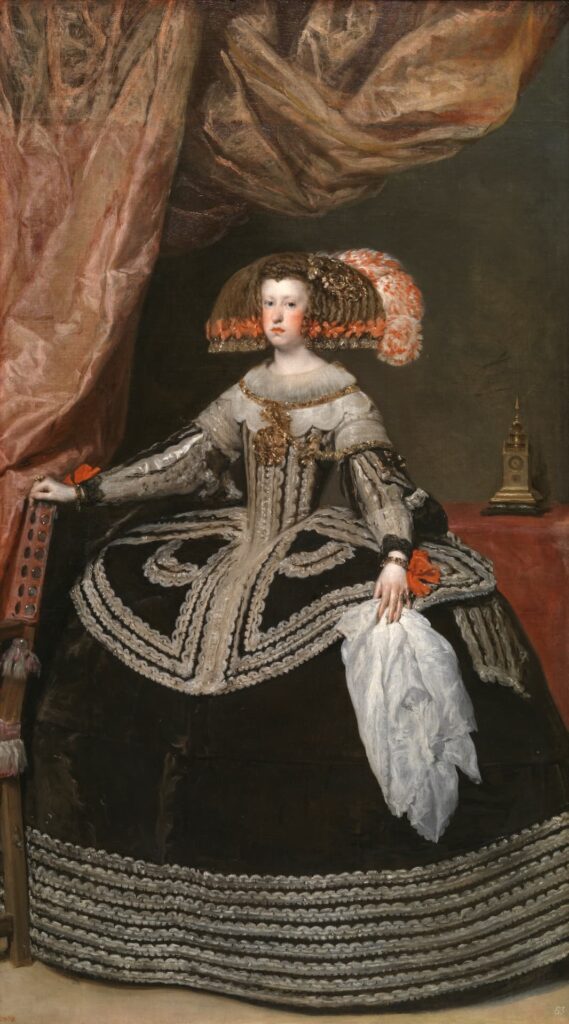
Mariana of Austria wears a dramatic black dress decorated with thick rows of silver trimming in Diego Velázquez’s iconic portrait of the queen (Figure 1). As is well-known, this was Velázquez’s first portrait of Philip IV’s young wife, painted after she had recovered from the birth of her first child, the infanta Margarita, on July 12, 1651. The image of Mariana in a striking black and silver dress reached an audience beyond the Spanish court: full-size copies of the painting were sent to the courts at Vienna and Versailles, among other places, and printed bust-length portraits made after Velázquez’s painting circulated even more widely. The dress does not survive today—precious few garments from this period do. But archival records documenting the work of the queen’s tailor, Mateo Aguado, make it possible to reconstruct—or deconstruct—the garment made famous by Velázquez’s portrait.
Mateo Aguado’s work for Queen Mariana is documented in charges (cargos) that were drawn up by don Francisco Gaztelu y Gamboa, the keeper of the queen’s jewels and wardrobe. The records begin in the summer of 1649, when Aguado traveled to Denia, on Spain’s Mediterranean coast, to meet the new queen when she disembarked after her long voyage from the Austrian court. These documents provide brief descriptions of each garment that the tailor made and the type and color of fabric and decorations that he used. Aguado made several different kinds of dress for the queen. The staple of the queen’s wardrobe was a three-piece dress with a long skirt, a doublet with fitted sleeves and a peplum (faldillas), and a sleeveless over-gown (ropa) with shoulder wings (brahones). Aguado also made the queen matched sets of bodices and petticoats in colorful silks and religious habits from dark brown wool. For special occasions, such as Candlemas and Palm Sunday, the queen wore a formal ensemble called a saya entera, which is the kind of dress that Mariana wears in her portrait by Velázquez.
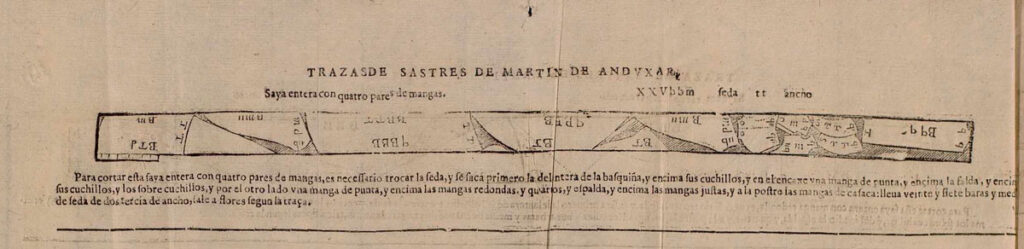
The saya entera was a two-piece dress with an upper-body garment (cuera) and a skirt (basquiña) that was cut longer in the back than in the front to form a train. The train is rarely visible in portraits, but the saya entera can be identified even in bust-length portraits thanks to the shoulder wings and superfluous hanging sleeves that are attached to the bodice. The 1640 tailoring manual by Martín de Andújar includes a pattern layout for a saya entera with functional fitted sleeves plus three different kinds of decorative sleeves: rounded sleeves, pointed sleeves, and tubular sleeves called mangas de casaca (Figure 2). In Velázquez’s portrait of Mariana, she wears mangas de casaca, which was the type of hanging sleeve that Aguado used exclusively starting in 1651. That same year, Aguado introduced a new kind of fitted sleeve, which Mariana also models in her portrait: made from three strips of decorated fabric, the sleeve’s wide openings reveal a white silk gauze undersleeve beneath it. The bodice of Mariana’s black and silver dress has an extra-large peplum divided into four parts with half-moon shaped openings in the front two quadrants, which were novelties that Aguado introduced in 1650. The exaggerated bell-like shape of the queen’s skirt was supported by a farthingale (guardainfante) with a supplemental hip (caderilla) made by the queen’s farthingale-maker, Diego López.
Mariana’s black and silver dress displays all of the new design features that Aguado had introduced to the queen’s wardrobe in 1650 and 1651, but none of the documented dresses that the tailor made for the queen in the early 1650s perfectly matches the dress in Velázquez’s painting. That dress appears to be made from a plain black velvet. Mariana rarely wore black, except on somber occasions, such as funerals and Palm Sunday. Of the nine sayas enteras that Aguado made for Mariana between 1650 and 1653, only two of them were black. The first one was for the queen to wear on Palm Sunday in 1650: made from a black silk velvet, it had long pointed sleeves and was embroidered with pieces of glass. The second black saya entera, which Aguado made from black Florentine satin for an unspecified occasion in 1652, had tubular hanging sleeves and was embroidered with mica in a diagonal design.
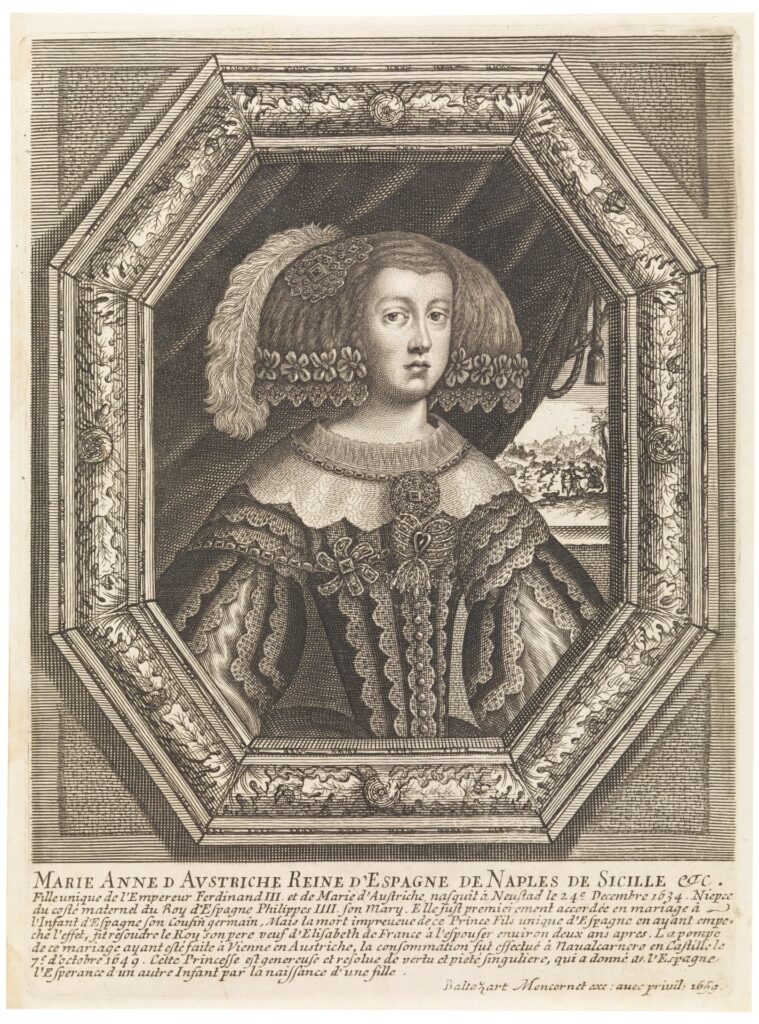
Figure 3. Unknown printmaker after Velázquez, Queen Mariana of Austria, 1659. Balthasar Moncornet, editor. Etching and engraving, 24.6 x 18.4 cm. Museo Nacional del Prado, Madrid. G002283. 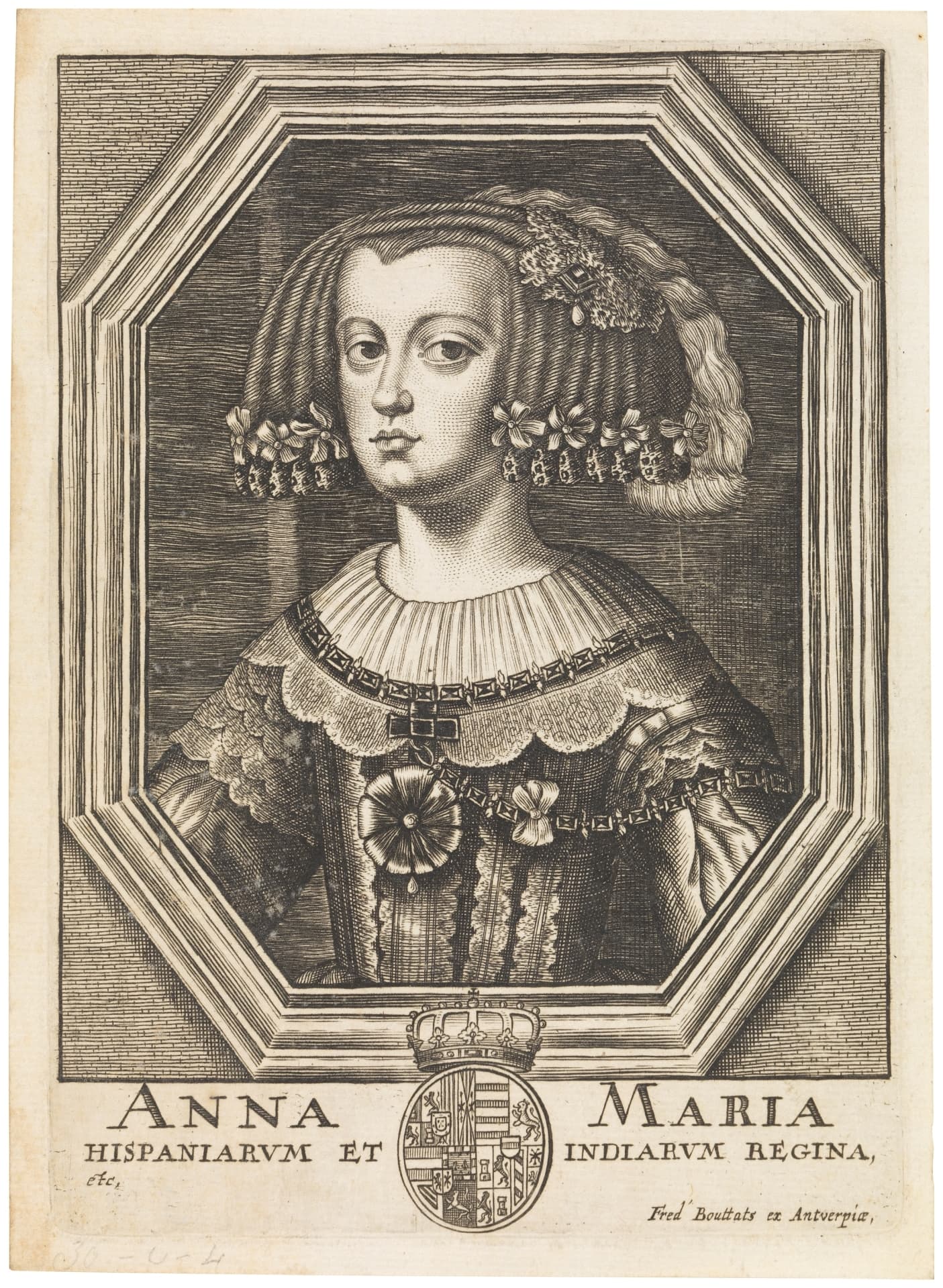
Figure 4. Unknown printmaker after Velázquez, Queen Mariana of Austria, 1653-1676. Frederik Bouttats, editor. Etching and engraving, 17.4 x 12.7 cm. Museo Nacional del Prado, Madrid. G002281.
The silver trimming on Mariana’s dress is the most difficult feature to decipher. Art historians have variously described the thick rows of chain-like ornamentation as embroidery, brocade, and braid—which are three structurally different techniques for decorating fabric. In Velázquez’s own time, artists who were tasked with reproducing his portrait of Mariana in print could not agree on how to interpret the brushwork of the silver decoration, which they represented very differently (Figures 3-4). Mateo Aguado’s cargos for the early 1650s reveal that the tailor employed many different kinds of dress decorations made from silver thread and silver plate, including woven and plaited trimmings and scallop-edged bobbin lace of different widths. Aguado often layered one kind of decoration over another, such as a silver lamé edging placed on top of black and silver passementerie. It is probably futile to try to identify exactly what type of decoration Velázquez represented on Mariana’s black dress, but the archival documentation does clarify the range of possibilities.[1]
In the final analysis, Mariana’s black and silver dress appears to be based on actual garments in the queen’s wardrobe, with a dash of invention on the part of the painter. The dress that we see in the portrait hews very closely in all its details to the archival records of the garments that were being made for the queen in the early 1650s, but the fact that there is no documented dress exactly like it suggests that Velázquez may have combined elements from multiple garments in the queen’s wardrobe to create this black velvet dress with heavy silver trim. Perhaps Velázquez used a saya entera with rows of silver decoration as a model and changed the color to black in order to suit the serious nature of an official state portrait. The iconic dress that resulted is the fruit of a collaborative effort between the skilled craftsmen who dressed the queen and the one who painted her portrait.
Archival Sources:
- Archivo General de Palacio, Madrid (AGP). Administración General (AG), leg. 904: Cargos of Mateo Aguado, tailor of the chamber, for Queen Mariana.
Selected Bibliography:
- Maribel Bandrés Oto, La moda en la pintura: Velázquez: Usos y costumbres del siglo 17 (Pamplona: EUNSA, 2002).
- Jonathan Brown and Carmen Garrido, Velázquez: The Technique of Genius (New Haven and London: Yale University Press, 2003).
- Antonio Domínguez Ortiz, Alfonso E. Pérez Sánchez, and Julián Gállego, Velázquez, exh. cat. (New York: Metropolitan Museum of Art, 1989).
- Peter Cherry, “Velázquez and the Making of Queen Mariana de Austria,” Libros de la corte, no. 28, año 16 (2024). https://doi.org/10.15366/ldc2024.16.28.015
- Mercedes Llorente, “La representación de dos reinas ibéricas: Luisa de Guzmán y Mariana de Austria,” in Mulheres da realeza ibérica mediadoras políticas e culturais, ed. Gonzalo del Puerto y Gil, Mercedes Llorente, and Renato Epifânio (Lisbon: Instituto Cervantes, 2019), pp. 159-88.
- José López Rey, Velázquez: Painter of Painters, 2 vols. (Cologne: Taschen, 1996).
- Laura Oliván Santaliestra, “Clothes Make the Queen: Mariana of Austria’s Style of Dress, from Archduchess to Queen Consort (1634-1665),” in Sartorial Politics in Early Modern Europe: Fashioning Women (Amsterdam: Amsterdam University Press, 2019), ed. Erin Griffey, pp. 207-26.
- Javier Portús, ed., Velázquez: Las Meninas and the Late Royal Portraits, exh. cat. (New York: Thames and Hudson, 2014).
- Amanda Wunder, “Mateo Aguado,” in Real Academia de la Historia, Diccionario Biográfico electrónico. https://dbe.rah.es/biografias/95523/mateo-aguado
- Amanda Wunder, Spanish Fashion in the Age of Velázquez: A Tailor at the Court of Philip IV (New Haven and London: Yale University Press, 2024). Spanish edition: La moda española en la época de Felipe IV: Un sastre en la corte de Felipe IV (Madrid: Ediciones El Viso, 2023).
Captions to works referred to in the text:
- Figure 1. Diego Rodríguez de Silva y Velázquez, Queen Mariana of Austria, 1652-1653. Oil on canvas, 234.2 x 132 cm. Museo Nacional del Prado, Madrid. P001191.
- Figure 2. Pattern layout for a formal dress (saya entera) with four pairs of sleeves, inMartín de Andújar, Geometria y trazas pertenecientes al oficio de sastres (Madrid: Imprenta del Reino, 1640). Biblioteca Nacional de España, Madrid. R/2493.
- Figure 3. Unknown printmaker after Velázquez, Queen Mariana of Austria, 1659. Balthasar Moncornet, editor. Etching and engraving, 24.6 x 18.4 cm. Museo Nacional del Prado, Madrid. G002283.
- Figure 4. Unknown printmaker after Velázquez, Queen Mariana of Austria, 1653-1676. Frederik Bouttats, editor. Etching and engraving, 17.4 x 12.7 cm. Museo Nacional del Prado, Madrid. G002281.
[1] Bandrés Oto (p. 319) identifies the silver trim in Velázquez’s portrait of Mariana as a type of galloon called sevillanitas, servillanitas, or majaderillos, but these terms do not appear in Aguado’s cargos for Mariana in the early 1650s. The silver decorations that Aguado did use for the queen at this time were galón and galoncicos; peinecillos; caracoles and caracolillos; puntas, puntas grandes, and punticas; and pasamanos de plata.