AGENART
Pieza del mes: mayo 2025
Autor: Peter Cherry
Cómo citar este artículo/How to cite this article: Peter Cherry, “Pottery Fit for a Queen”, Agenart: La agencia artística de las mujeres de la Casa de Austria, 1532-1700, 21 de mayo de 2025. Consultado: 6 de septiembre de 2026. URL: https://agenart.org/pottery-fit-for-a-queen
On 18 September 1661, Queen Mariana de Austria ordered payment to the royal goldsmith Francisco Enríquez for mounting in gold filigree twelve pottery vessels from Natán (“barros de Natá”) and in silver filigree twenty-four pottery vessels (“barros”) as a post-partum gift to be sent to her step-daughter María Teresa, Queen of France, who had given birth to Louis, the Grand Dauphin. Why would royal women consider these objects as suitable and sought-after gifts?

These pottery objects had been made in the Spanish colonies of South America and were generically called barros in Spain. Sebastián de Covarrubias’ Tesoro de la lengua castellana, o española (1611) described the búcaro as a red-clay vessel from Portugal, but this term was subsequently also applied to those made beyond Europe. The barros given by Mariana de Austria and denominated as from Natá were from present-day central Panama, while the others were probably the more common red-ware pottery with a polished engobe slip from Tonalá in today’s Mexico. The objects were a veritable fashion among elites in Spain, and they were imported by merchants and members of the colonial administration via the bullion fleets and also via the port of Lisbon. Their origins in the colonial world gave these vessels a particular cachet when they reached Europe, but they were quickly absorbed into the customs of Spanish consumers. Barros were converted into luxury objects when mounted in silver or gold from the imperial mines, thus transforming a pottery vessel of relatively little value into something far more costly and desirable, as was the case with those sent from the queen to her stepdaughter.
Barros were made for use, and in Spain they were mainly employed for drinking water. The thin, porous walls of the unglazed vessels permitted evaporation and kept the water fresh, and the clay itself was said to have emitted a pleasant earthy fragrance. The objectsgenerally appear in this guise in elegant still-life paintings of the period. But another reason for their presence in these pictures was that they were collectibles and were particularly appreciated as such by elite women.
Indeed, like glassware, some ceramics were elaborate one-off pieces de invención—such as the one from the royal collections illustrated here (Figure 1)—and were evidently designed for display in camarines and other spaces frequented by women. In Covarrubias’ Tesoro, the camarín was defined as a small room where gentlewomen displayed their collections of porcelain, barros, glassware, and other curious things (“el retrete donde tienen las señoras sus porcelanas, barros, vidrios, y otras cosas curiosas”). Later in the century, the camarín was replaced by the glazed cabinet or escaparate for the display of glassware and ceramic objects. Luxury and ostentation were generally manifested by the cumulative visual impact of the sheer number and variety of objects assembled. To cite one famous example, Santa Teresa in her Moradas del castillo interior writes that she was overwhelmed by the camarín of the Duchess of Alba. Similarly, the camarín inventoried in 1605 in the urban house and garden of the Duke of Lerma, privado of Philip III— displaying over 850 objects on shelves on the four walls of the room—was one of the most distinguished of its kind and was doubtless admired by the king and queen on their visits to the property. While it has been assumed that this was the work of the duke himself, the associations of such spaces with the collecting habits of women posit a role, albeit to be documented, for Catalina de la Cerda, Duchess of Lerma (d. 1603). Unfortunately, it remains unclear where and how the queens displayed their pottery collections.
The groups of objects which were gathered into camarines can, in fact, be denominated collections; there is coherence in the genus of objects assembled and organization in their visual display, and they required the admiring gazes of visitors. The pleasure of such collections for owners and visitors may have flowed from looking at novel, curious, and attractive objects of a decorative nature composed to striking visual effect. Camarines may have been spaces of female sociability, like oratories, about which little is presently known.
A connoisseurship of these objects developed. In response to a European taste for owning búcaros, the Florentine courtier and natural philosopher Count Lorenzo Magalotti guided the Marchioness Ottavia Renzi Strozzi on the objects in eight letters written to her in 1695. The taste for búcaros appears to have spread to Tuscany as a result of the journey to Spain of Cosimo III de’ Medici in 1668-69. According to Magalotti, red-ware vessels from Santiago (Chile) were distinguished for their colour and glossy shine, their design and workmanship. They were said to compare favourably to European pots from Estremoz in Portugal in workmanship and decoration, although they were not as finely made.
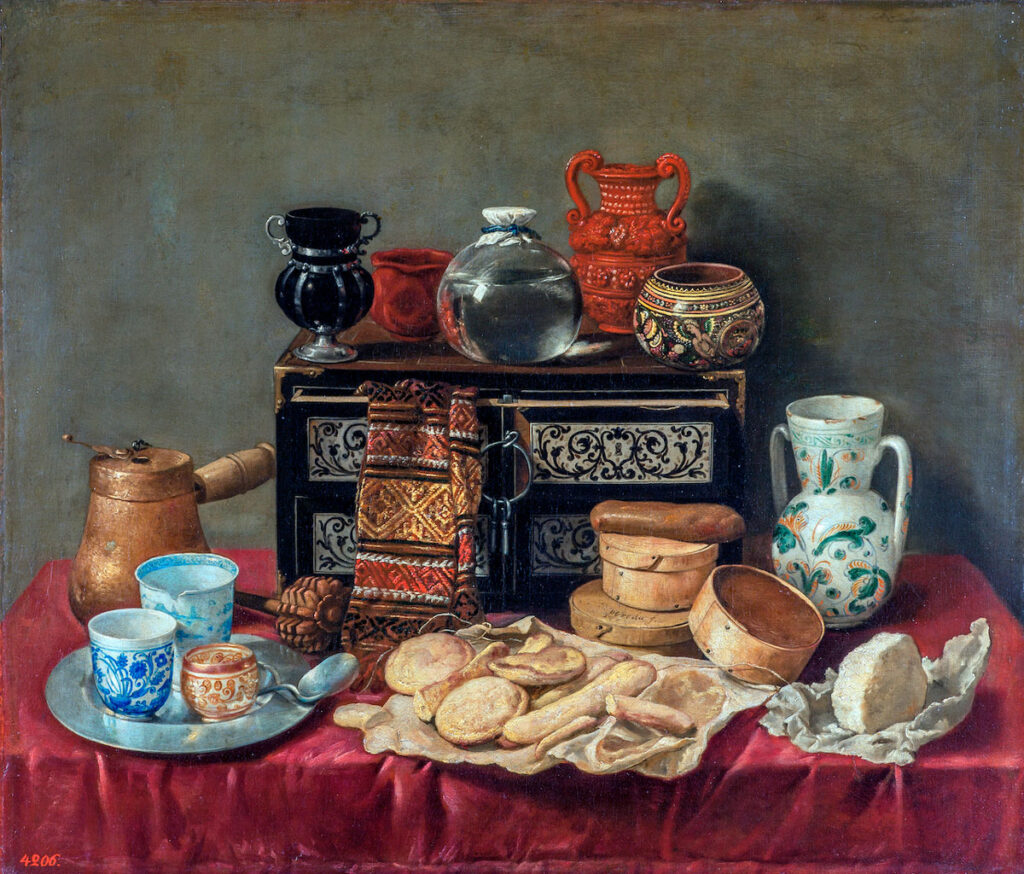
The aromatic property of clays is one of the main themes of Magalotti’s letters, with all of its implications for their medicinal and therapeutic properties. Moistened búcaros held in the hand or placed against the face or chest of a woman were said to reduce fevers, and fragments applied to the temples cured headaches. Magalotti observed that the perfume of vessels from Guadalajara (Mexico) made them more highly appreciated than those from Chile, although they were inferior to the latter in colour, design, and workmanship, and had thicker clay walls. He went on to say that black clay vessels (barros negros)from Natán (or Natá) in Panamá were very fragrant and of very delicate manufacture. He noted that these were rarely found in collections, but were the most sought-after and fashionable of all, and the ones which were most often mounted in silver. A burnished one of these can be seen in the left background of Antonio de Pereda’s Still Life with an Ebony Chest (St. Petersburg, Hermitage Museum) among many other “exotic” things associated with the social ritual of chocolate drinking (Figure 2).
Gendered taste for the consumption of barros took on a literal sense in the social phenomenon of urban young ladies nibbling, eating, and savouring broken pieces of the pottery, a practice that was acknowledged in medical, social, and artistic discourses of the time. Juan de Zabaleta satirized the habit in his El día de la fiesta por la tarde (1659) in his fictional account of a merienda in the richly appointed reception room, or estrado, of a private house in Madrid. Here, the wife of a governor in South America arrived with her daughter, who was described as having a distended stomach and was deathly pale from eating barro. The mother accidently broke with her skirts a barro from Natá on a side-table and promised to repay her hostess with half a dozen in the first box of these sent to Madrid by her husband. The hostess graciously declared the accident a blessing in disguise, given her constant desire to drink water from the vessel; the daughter, meanwhile, was discovered to be surreptitiously consuming pieces of it. The main reason for the practice was cosmetic; it was said to help clay-eaters attain a socially desirable pale complexion. They manipulated their bodies in this way despite the dangers to their health. The etiology of the practice involved oppilation (opilación), or the obstruction of the gastroenteric system, and a consequent pronounced swelling of the stomach. Adolescent clay-eaters could also be seen at the time to be suffering from the condition known as chlorosis, whose popular names include the green sickness or “disease of virgins”, since pica, or the eating of non-food substances, was regarded as one of its dietary symptoms. There was also an erotic dimension to the wan, sickly pallor of sufferers which could be construed as a symptom of “love-sickness”, a condition to which pubescent girls were regarded as particularly vulnerable.
These cultural phenomena, however, would appear to have been far from the mind of Mariana de Austria in her gifts to the twenty-three-year-old new mother. Still, they are indicative of the multiple aspects of desirability which South American barros embodied for female elites. An imminent exhibition at the Museo de América in Madrid on the búcaro will showcase the extensive collections of these objects assembled in the late seventeenth century by the Condesa de Oñate and promises to address some of the questions around the fascination exercised by these objects on the eyes, minds, and bodies of women of the past.
Selected Bibliography:
- P. Cherry, “Objects and Objectives in the Courtly Still-Life Paintings of Juan van der Hamen”, in La corte de Felipe IV (1621-1665): reconfiguración de la monarquía católica, eds. J. Martínez Millán and M. Rivero Rodríguez, Part III, Corte y cultura en la época de Felipe IV, vol. 4, Felipe IV y las artes, ed. Mercedes Simal López, Madrid: Ediciones Polifemo, 2017, pp. 2791-2870.
- M. C. García Sáiz and J. L. Barrio Moya, “Presencia de cerámica colonial mexicana en España”, Anales del Instituto de Investigaciones Estéticas, 58, 1987, pp. 103-110.
- A. Gutiérrez Usillos (curator), Búcaros. Valor del agua y exaltación de los sentidos en los siglos XVII y XVIII, Museo de América, Madrid, May 23-October 19, 2025. https://www.cultura.gob.es/museodeamerica/exposiciones/2025-bucaros.html.
- B. E. Hamann, “The Mirrors of Las Meninas: Cochineal, Silver, and Clay”, Art Bulletin, XCII, 2010, pp. 6-35.
- H. King, The Disease of Virgins: Green Sickness, Chlorosis, and the Problems of Puberty, New York: Routledge, 2004.
- “Let Them Eat Clay: Mexican Búcaros Ceramics · V&A”, Victoria and Albert Museum, accessed May 19, 2025, https://www.vam.ac.uk/articles/let-them-eat-clay-mexican-bucaros-ceramics.
- M. L. López Terrada, “‘Sallow-faced girl, either it’s love or you’ve been eating clay’: The Representation of Illness in Golden-Age Theatre”, in Medical Cultures of the Early Modern Spanish Empire, Farnham: Ashgate, 2014, pp. 167-88.
- L. Magalotti, Lettere sopra le terre odorose d’Europa e d’America dette volgarmente buccheri (1695), in F. Perujo and T. Poggi Salani, eds.,“De los búcaros de las Indias Occidentales” of Lorenzo Magalotti (1695)”, Boletín del Instituto de Investigaciones Bibliográficas, 8, 1972, pp. 319-54.
- A. Pleguezuelo Hernández, “Cerámicas para agua en el barroco español: una primera aproximación desde la literatura y la pintura”, Ars Longa, 2000, pp. 123-138.
- C. Ripollés, “A Still Life of Global Dimensions: Antonio de Pereda’s Still Life with Ebony Chest,” in Smarthistory, September 26, 2018, https://smarthistory.org/pereda-still-life-w-ebony-chest/.
- B. E. Roviro and F. Gaitán, “Los búcaros. De las Indias para el mundo”, Canto Rodado, 5, 2010, pp. 39-78.
- S. Schroth, “The Duke of Lerma’s Palace in Madrid: A Reconstruction of the Original Setting for Cristoforo Stati’s ‘Samson and the Lion’”, Apollo Magazine, vol. 159, no. 474 (2001), pp. 11-21.
- N. Seseña, “El búcaro de Las Meninas”, Velázquez y el arte de su tiempo, V Jornadas de Arte, Departamento de Historia del Arte “Diego Velázquez”, Consejo Superior de Investigaciones Científicas, Madrid, 1991, pp. 39-48.
Captions to works referred to in the text:
- Figure 1. Red Clay Barro de Tonelá (Mexico), seventeenth century, 27 x 14 cm. Photo: Mario Sedeño. Galería de las Colecciones Reales, Madrid, Patrimonio Nacional, 00618472.
- Figure 2. Antonio de Pereda, Still-Life with an Ebony Chest, 1652, oil on canvas, 80 x 94 cm. The State Hermitage Museum, Saint Petersburg, WGA17174.