AGENART
Pieza del mes: octubre 2024
Autora invitada: Rebecca Teresi
Cómo citar este artículo/How to cite this article: Rebecca Teresi, “Margaret of Austria’s Portrait and the Anglo-Spanish Peace of 1605”, Agenart: La agencia artística de las mujeres de la Casa de Austria, 1532-1700, 1 de octubre de 2024. Consultado: 6 de septiembre de 2026. URL: https://agenart.org/margaret-of-austrias-portrait-and-the-anglo-spanish-peace-of-1605/
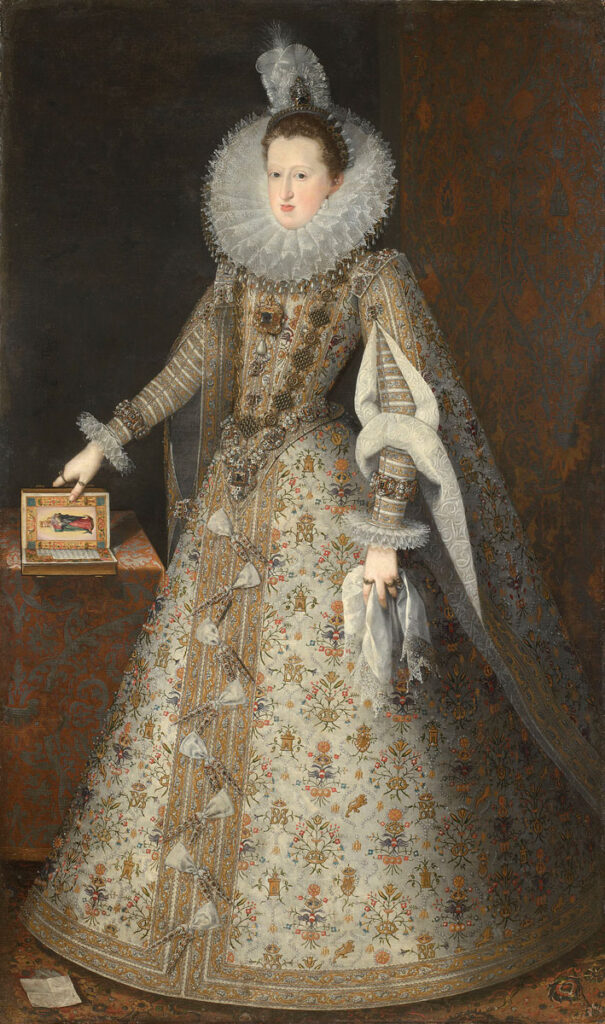
In Juan Pantoja de la Cruz’s 1605 portrait of Queen Margaret of Austria (1584-1611) held in the British Royal Collection (Figure 1), the young queen, clad in a dazzling gown, stands in a lush interior space. Directly engaging the viewer with a frank gaze, her
brilliantly lit, doll-like face is surrounded by an elaborately starched ruff from which dangle an astounding seventy teardrop pearls. The famous joyel rico jewel hangs at her breast. Her saya, or gown, is richly spangled with pearls, daisies, and the heraldic lions, castles, and double eagles of the Crown of Castilla y León and the Habsburg dynasty, respectively, throwing the full weight of her family’s vast Catholic empire behind the portrait. Her right hand gestures to an open book of hours featuring an image of the Virgin and Child, proclaiming her well-known devotion, while her left hand delicately grasps a lace-edged handkerchief. It is a triumph of queenly splendor and piety rendered in Pantoja’s most exquisite style.
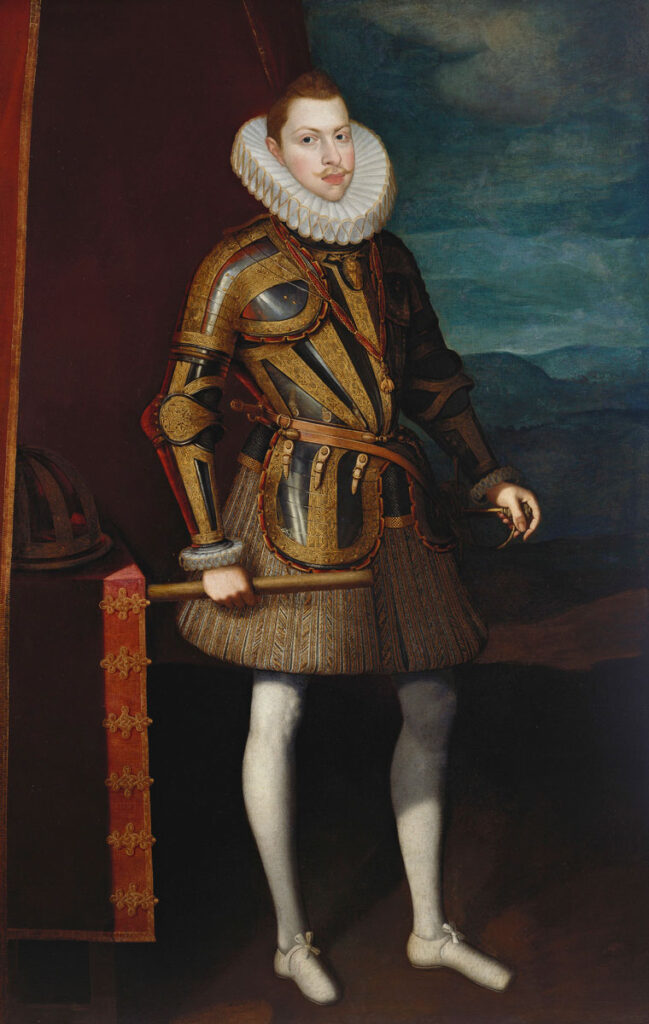
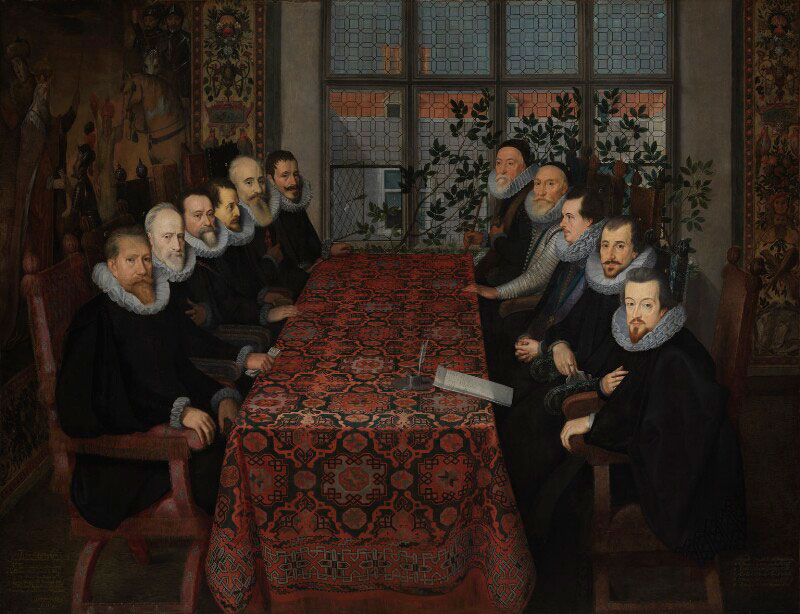
Of the many portraits of Queen Margaret of Austria painted by Philip III’s court painter Juan Pantoja de la Cruz, this is one of the most splendid. Conceived as part of a series of diplomatic gifts marking the end of nearly twenty years of hostilities between England and Spain, it was sent along with a pendant portrait of Philip III (Figure 2) and a third, lost portrait of the Infanta Ana to the English court following the signing of the Treaty of London in 1604, a landmark event depicted in a famous group portrait now at the National Portrait Gallery (Figure 3). More than a feast for the eyes, Margaret’s portrait is a unique example of the way in which Pantoja subtly, or in this case, not so subtly, altered his somewhat formulaic images to adapt to diverse dynastic and diplomatic contexts. It is also, and perhaps most importantly, a striking example of the greater time, money, and strategic effort that was occasionally invested in portraits of queens consort over and above those of the monarch.
Comparing Margaret’s portrait to others made by Pantoja around the same time, such as the example at the Prado painted the following year (Figure 4), reveals the greater care taken in the execution of the consort’s portrait destined for England. The Prado version, which remained in Spain, shows a much simpler gown, a closed book, and plain red as opposed to damask hangings in the background. By contrast, very few changes were made to Philip’s English portrait from previous and successive models (compare to the Prado version from 1606) (Figure 5); there is scarcely any difference between the portrait of the king sent to England and the one that remained at home. The increased investment in Margaret’s portrait compared to Philip’s is not only a question of aesthetics. Pantoja’s register indicates that the queen’s English portrait cost more than double what was billed for the king’s.[i] Margaret’s portrait was clearly the priority.
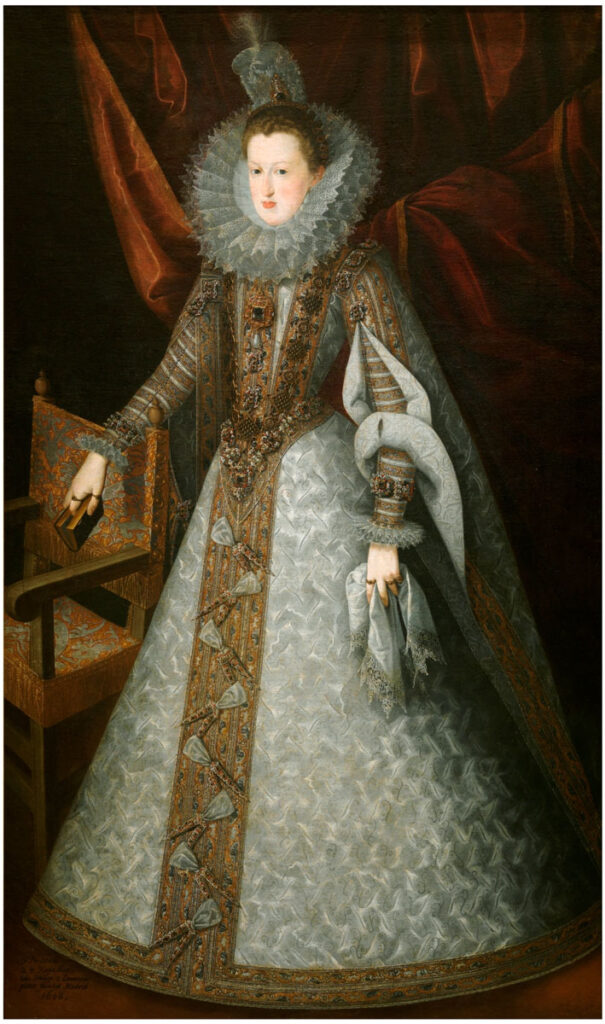
Figure 4. Juan Pantoja de la Cruz, Queen Margaret of Austria, 1606, oil on canvas, 207 x 122 cm, Museo Nacional del Prado, Madrid. 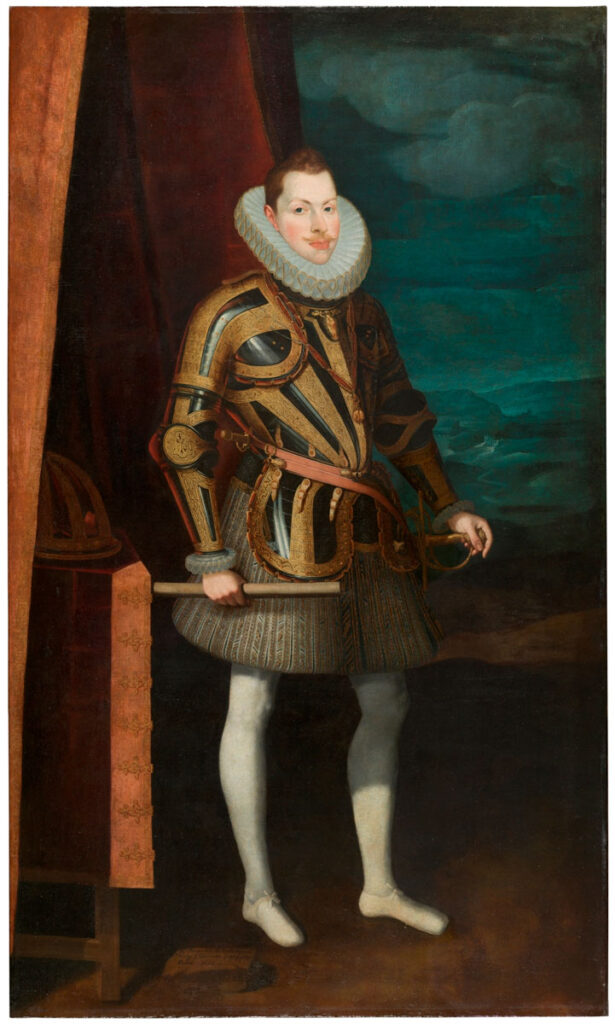
Figure 5. Juan Pantoja de la Cruz, Philip III, 1606, oil on canvas, 204 x 122 cm, Museo Nacional del Prado, Madrid.
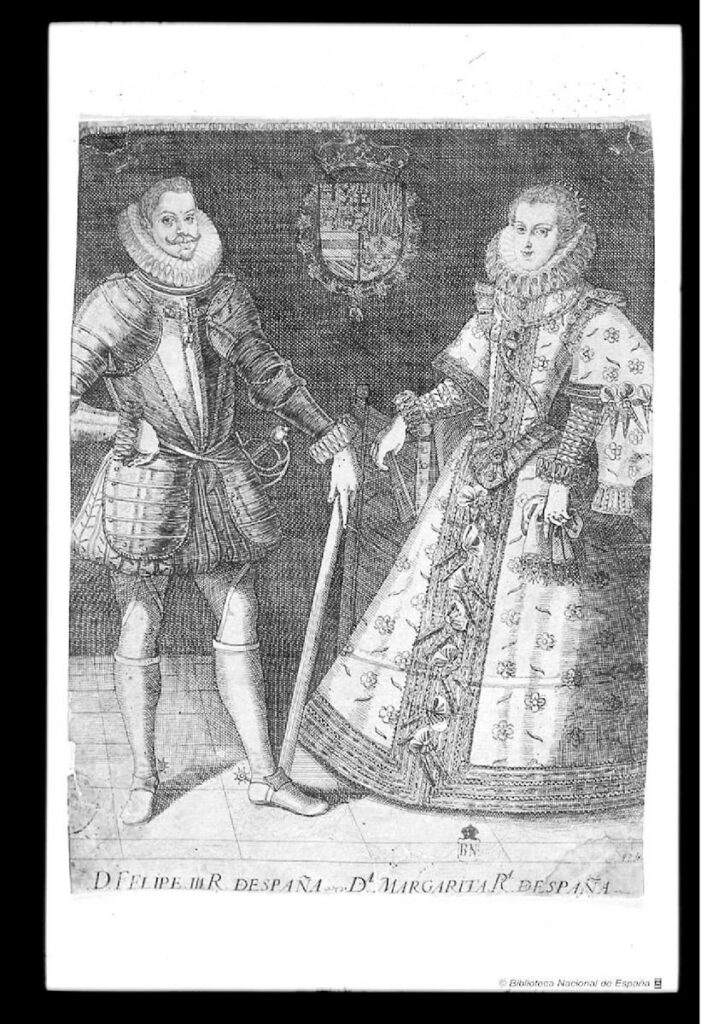
The most striking changes between the Royal Collection and Prado versions of Margaret’s portrait are the gown and the book of hours. Pantoja’s own description of the portrait reveals that this richly ornamented costume was in fact the wedding garment of the Habsburg queen:
Our Lord the King also owes [payment] for a full-length portrait of Our Lady the Queen, dressed in white in the same gown she wore on her wedding day, […] the portrait has been valued by three painters at four thousand reales; it was made to be sent to England.
Deue más el Rey Nuestro Señor vn retrato entero de la Reyna Nuestra Señora, bestida de blanco con la misma saya que saco el dia que se casó, […] está [el retrato] tasado por tres pintores en cuatro mil reales; fue para ynbiar a Yngalatera.[ii]
This is confirmed by an intaglio double portrait commemorating the union (Figure 6) (BNE, IH/2947/70), possibly a gesture towards the potential for a future match between the two monarchs’ children, in preliminary, but ultimately fruitless, discussion at the time. In no other portrait of the Spanish queen do these marriage clothes appear.
Even more dramatic is the change in the sitter’s actions from one portrait to the next. In the later Prado portrait, Margaret poses with a small book of hours in her right hand with a finger inserted between the pages, marking her place in anticipation of the moment when she might again turn to her prayers. This subtle detail was no doubt included to illustrate the queen’s personal piety and devotion, a recurring trope in the representation of Habsburg women at the Spanish court. In the London portrait, Margaret boldly opens the book, inviting the viewer in both her rigid posture and alert gaze to study its revealed contents. She has opened the book with her thumb and forefinger, not as she might in the course of her own devotional study, but in a clear gesture of demonstration, leaving the image visible only to the viewer. She is not reading but inviting the viewer to read, perhaps a pointed message directed to the Protestant court of James I and Anna of Denmark. And in fact, the question of religion and the toleration of English Catholics had been a key yet still unresolved component of the peace negotiations as well as the ongoing discussion of a match between the infanta and the Prince of Wales.
Margaret was known to favor extremely stylized—and one might say extremely provocative—religious portraiture commissioned from Pantoja. A useful comparison to the London commission is a much more private portrait painted less than a year before (Figure 7), when the queen was pregnant with the future heir. Commissioned to be sent to her relatives in Austria, this striking retrato a lo divino depicts the expectant Margaret as the Virgin of the Annunciation, her daughter Ana as the angel Gabriel, their distinctive Habsburg features unmistakable. This was one of several “divine portraits” the artist would paint for the queen, depicting Margaret and her family as not only witnesses to, but active participants in, sacred history. These provocatively pious commissions are evidence that Margaret was keenly aware of the rhetorical potential of her portraiture, collaborating with Pantoja to produce distinctly stylized images of queenship.
That an extremely sensitive portrait—gifted at a time of new and fragile peace between two world powers—was made at such great expense, and that double the expense and visual effort was invested in that of the queen consort rather than the king, tells us much about the power of patronage of Habsburg women. This episode reveals the unique potential of early modern state portraiture as a tool for the exercise of female power in a male-dominated political world. The exchange of queenly portraits, splendor and all, was not merely ornamental.
Selected Bibliography
- María Cruz de Carlos Varona, “Reginalidad y retrato en las cortes de Felipe III y Felipe IV,” in Anima: Pintar el rostre i l’esperit, ed. Pablo González Tornel(Gijón: Trea, 2022), 146-198.
- Adam Jasienski, Praying to Portraits: Audience, Identity, and the Inquisition in the Early Modern Hispanic World (University Park: Penn State University Press, 2023).
- Maria Kusche, Juan Pantoja de la Cruz y sus seguidores: B. González, R. de Villandrando y A. López Polanco (Madrid: Fundación Arte Hispánico, 2007).
- Ruth de la Puerta Escribano, La Segunda Piel: historia del traje en España (del siglo XVI al XIX) (Valencia: Biblioteca Valenciana, 2006).
- Sarah Schroth, “Re-Presenting Philip III and His Favorite: Changes in Court Portraiture 1598-1621,” Boletín del Museo del Prado 17, no. 36 (2000): 39-50.
- Rebecca Teresi, “Images of the Immaculate Conception and the Rhetorics of Purity in Golden Age Spain,” (PhD diss., Johns Hopkins University, 2021).
- Gustav Ungerer, “Juan Pantoja de la Cruz and the Circulation of Gifts Between the English and Spanish Courts in 1604/5,” Sederi 9 (1998): 59-78.
List of Illustrations
- Figure 1. Juan Pantoja de la Cruz, Margaret of Austria, c. 1605, oil on canvas, 204.6 x 121.2 cm, Royal Collection Trust, United Kingdom. © Royal Collection Enterprises Limited 2024 | Royal Collection Trust.
- Figure 2. Juan Pantoja de la Cruz, Philip III, c. 1605, oil on canvas, 184.4 x 118.5 cm, Royal Collection Trust, United Kingdom. © Royal Collection Enterprises Limited 2024 | Royal Collection Trust.
- Figure 3. Unknown Artist, The Somerset House Conference, 1604, 1604, oil on canvas, 205.7 x 268 cm, National Portrait Gallery, London. NPG 665.
- Figure 4. Juan Pantoja de la Cruz, Queen Margaret of Austria, 1606, oil on canvas, 207 x 122 cm, Museo Nacional del Prado, Madrid.
- Figure 5. Juan Pantoja de la Cruz, Philip III, 1606, oil on canvas, 204 x 122 cm, Museo Nacional del Prado, Madrid.
- Figure 6. Pedro Perret, Portrait of Philip III and Margaret of Austria, c. 1598, intaglio print, 252 x 182 mm, Biblioteca Nacional de España, Madrid.
- Figure 7. Juan Pantoja de la Cruz, Annunciation with Queen Margaret of Austria and the Infanta Ana, c. 1604, oil on canvas, 152 x 115 cm, Kunsthistorisches Museum, Vienna. https://www.khm.at/objektdb/detail/2373/?offset=6&lv=list
[i] Margaret’s portrait was valued at 4,000 reales, double that of the king’s at 2,000 reales and quadruple that of Ana’s at 1,000 reales. Kusche, 121.
[ii] Kusche, 481-82. Translation is mine.