AGENART
Pieza del mes: noviembre 2025
Autora invitada: Sarah Moran
Cómo citar este artículo/How to cite this article: Sarah Moran, «The Infanta Isabel Clara Eugenia in the Park at Mariemont», Agenart: La agencia artística de las mujeres de la Casa de Austria, 1532-1700, 06 de noviembre de 2025. Consultado: 28 de julio de 2026. URL: https://agenart.org/the-infanta-isabel-clara-eugenia-in-the-park-at-mariemont
The Infanta Isabel Clara Eugenia in the Park at Mariemont (Figure 1), executed by Jan I Breughel and Joos II de Momper probably between 1617 and 1621 and now in the Prado, is an enchanting painting. Measuring a bit less than two meters tall and over two wide, the canvas offers a view onto a verdant landscape of rolling hills, painted in such exquisite detail that one can almost count the leaves on the trees. The setting for this idyllic scene is the park at Mariemont, a site about seventy kilometers south of Brussels. At lower left, a group of richly dressed figures strolls into the scene. Close inspection reveals that they are nearly all women and little girls. At the front of the party, wearing a dark green dress and straw hat, is the Archduchess and Spanish Infanta Isabel Clara Eugenia (1566-1633), and the one man, wearing a black coat, is her husband Archduke Albert of Austria (1559-1621).
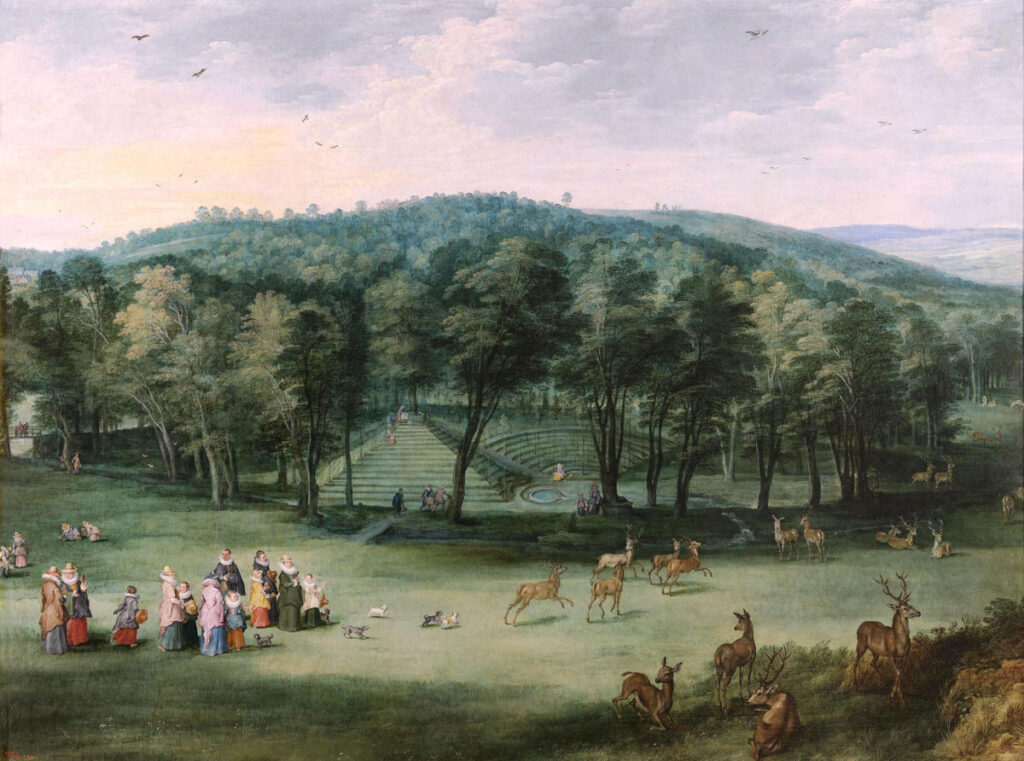
Several small dogs bound ahead of the group, barking at a herd of deer, which are mostly unbothered by their presence. In the middle ground, hidden between the trees, is an area that has been meticulously landscaped, with stairs carved into the hill to create both a three-sided pyramid and a small amphitheater. A basin has been dug around a natural spring and lined with stone, with an outlet on the right side to let the water flow away and into a small stream. Two men, carrying a heavy basket or box, have just crossed a small footbridge over that stream, and at the top of the pyramid is a table, where a man and woman are laying out a meal for the approaching courtiers.
Isabel and Albert as Sovereigns
Isabel and Albert had been made sovereign governors of the Low Countries, an area roughly comprising modern-day Belgium and the Netherlands, upon their marriage in 1598. Both had grown up at the court of Madrid: Isabel was the eldest daughter of Philip II, and Albert was his nephew, son of his sister Maria. In those years, there was no hint that the two would eventually wed. As a young child, Isabel was betrothed to Emperor Rudolf II, and when Rudolf broke that agreement, Philip pursued various plans to make her Queen of England or Queen of France. Albert, on the other hand, had been a pious youth destined for the Church, becoming a cardinal in 1577 at age eighteen. In 1596, Philip called on him to take up the post of governor of the Low Countries, territories the king had inherited from his father, Charles V, and which had long been challenging to manage.
By 1598, Philip’s health was failing, and plans to put Isabel on a foreign throne had fallen through. She was, moreover, already thirty-two years old, and needed to wed soon if she were to produce an heir. The king determined to marry her to Albert and that the couple would rule the Low Countries as independent sovereigns, which would hopefully quell some local political unrest. Albert laid his priestly robes aside, and the two were married. It was, however, a contingent sort of sovereignty: the crown of Spain retained the right to approve their descendants’ marriages, and if Isabel and Albert had no heir, the Low Countries would revert to Spain. As it turned out, the couple would indeed remain childless, and the region would return to Spanish control when Albert died in 1621.
Mariemont as Summer Residence
Shortly after their arrival in Brussels, the couple began surveying their new holdings. Renovating the courtly seats became a priority. Work soon began on the Coudenberg palace in Brussels, the nearby hunting lodge of Tervuren, and, to the south in the County of Hainault, the castle of Binche and another lodge called Mariemont. Both the Binche castle and Mariemont had been built in 1546 by a previous Low Countries governor: Mary of Hungary, Charles V’s sister and Isabel’s great aunt. Mariemont had been little used since Mary’s death in 1556. When Isabel and Albert arrived, they found the building relatively small, sparsely furnished, and in need of repairs; however, the forest offered excellent hunting grounds, and the climate was perfect for a summer residence.
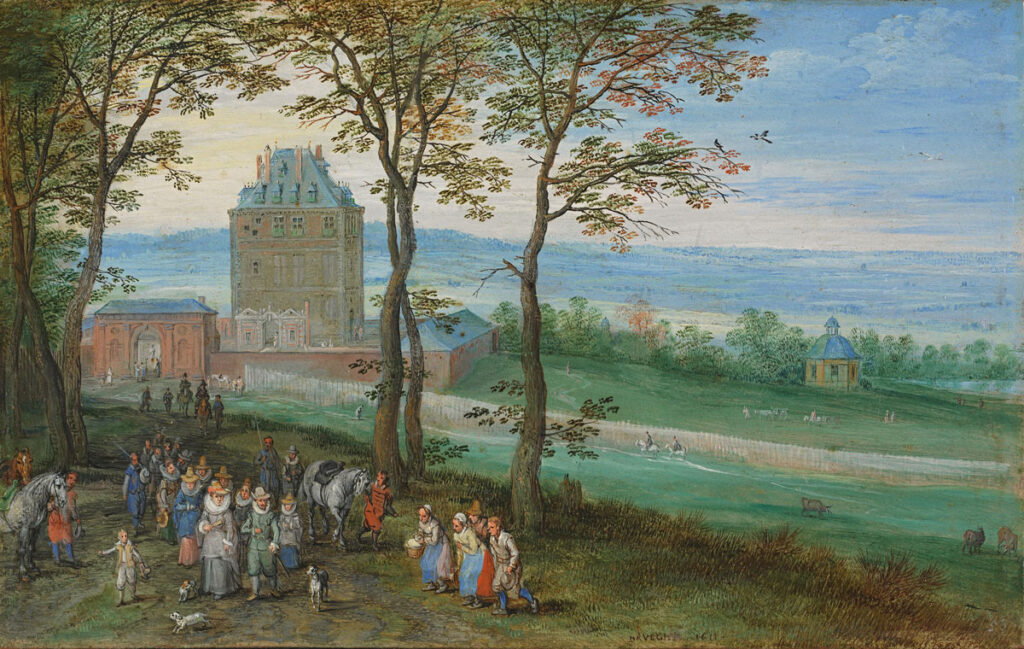
The renovation of Mariemont began in 1605. Although both the archduchess and the archduke visited regularly to oversee progress, Mariemont became Isabel’s project, while Albert focused more on Tervuren. Isabel endeavored to turn the old hunting lodge into a proper royal seat, with details modeled on the Aranjuez palace built by her father, where she had spent time in her youth. By the spring of 1608, Mariemont was ready to host the court, and the archducal entourage moved in to stay for the summer. The main building (see Figure 2) remained quite cramped – Isabel’s ladies had to all sleep in one room – so an expansion project continued for about another decade. A rectangular complex with stables and lodgings was built to the left of the main gate, galleries and gardens were installed, and large additions were erected at each of the four corners of the original structure, with work mostly finished by 1618 (see Figure 3).
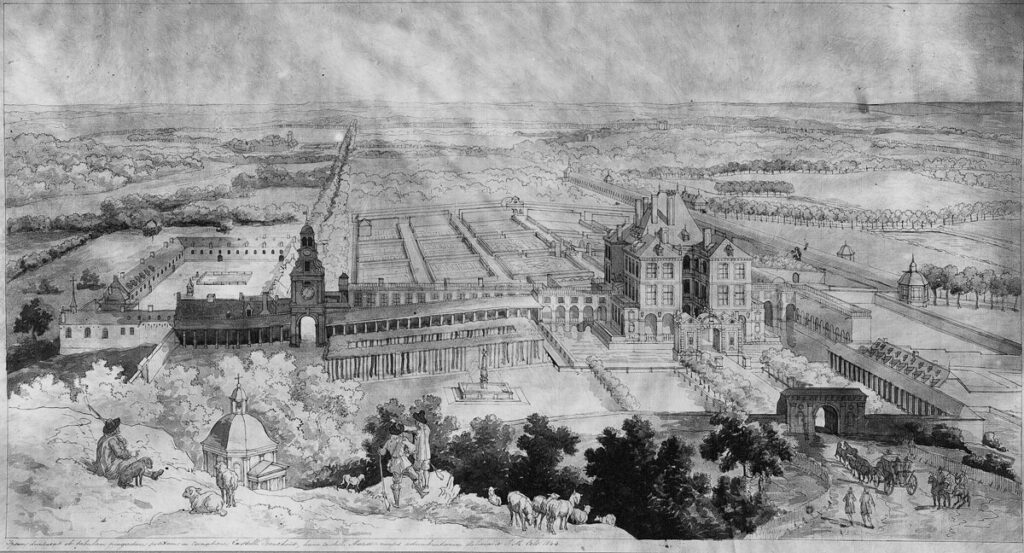
Figure 3. J. M. Cels, View of the Castle of Mariemont, 1844, engraving after a painting of c. 1620 or later. Mariemont, Musée de Mariemont. 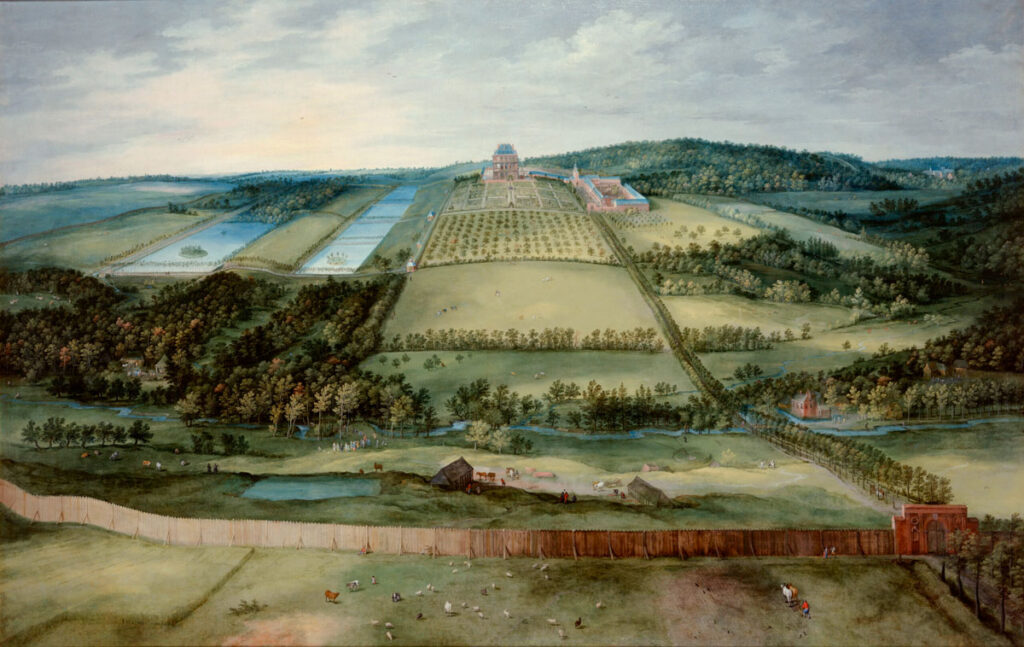
Figure 4. Jan I Breughel, View of Mariemont, 1612, oil on canvas, 186 x 292 cm. Dijon, Musée des Beaux-Arts de Dijon.
Isabel was not too troubled by the ongoing construction, since for her the main point of summering at Mariemont was to enjoy nature. The archduchess delighted in the park, spending her time walking, picnicking, and most importantly hunting. She was an excellent rider, and she took pride in her ability to take down a kill. She wrote to her young nephew, Philip III, about her embarrassment at having missed a shot at a deer:
I must now tell you something about our hunt at Mariemont. And since it is not to my honor, it will be on condition that Your Majesty laughs a little but does not make fun of me. We hunted all day, eating on the go (…) and toward evening a stag came within good range. I thought I had struck him squarely. My cousin and the hunters swore that he had fallen. We followed in the direction where he had disappeared and searched with the bloodhound until nightfall, I being quite pleased with my shot. At dawn the next morning we went in search of him with three hounds and our people (…). Around six in the morning one gamekeeper shouted to the others, ‘There he is!’ (…) But when they reached the spot from which the man had cried out, they saw my arrow driven into the middle of a tree, so deeply, straight, that one would have had to cut the tree down to pull it out. Thus, instead of a stag, I had killed a tree, while the other went off in perfect health.[1]
Mariemont as Symbol of Sovereignty
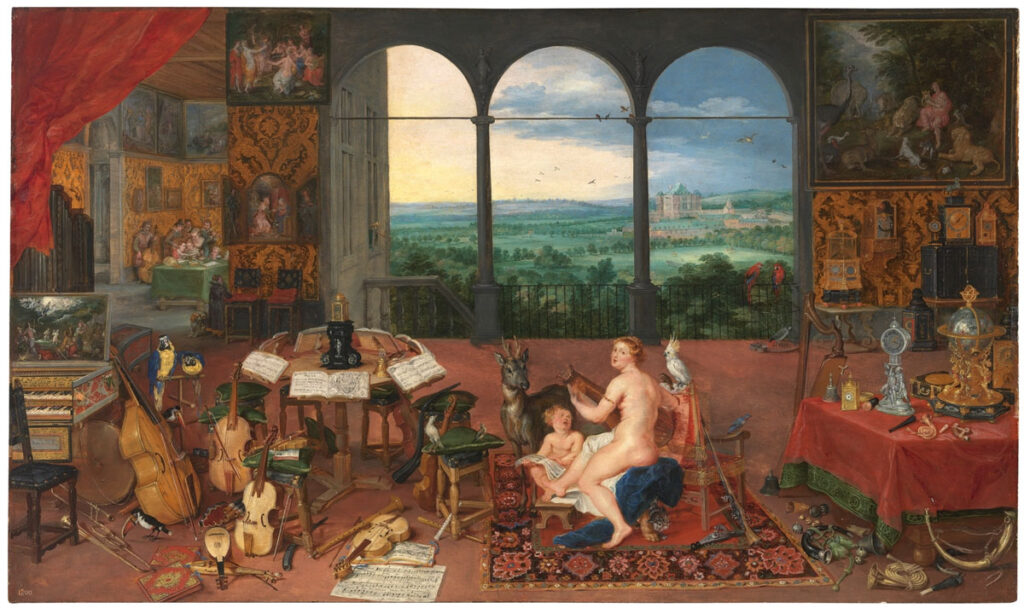
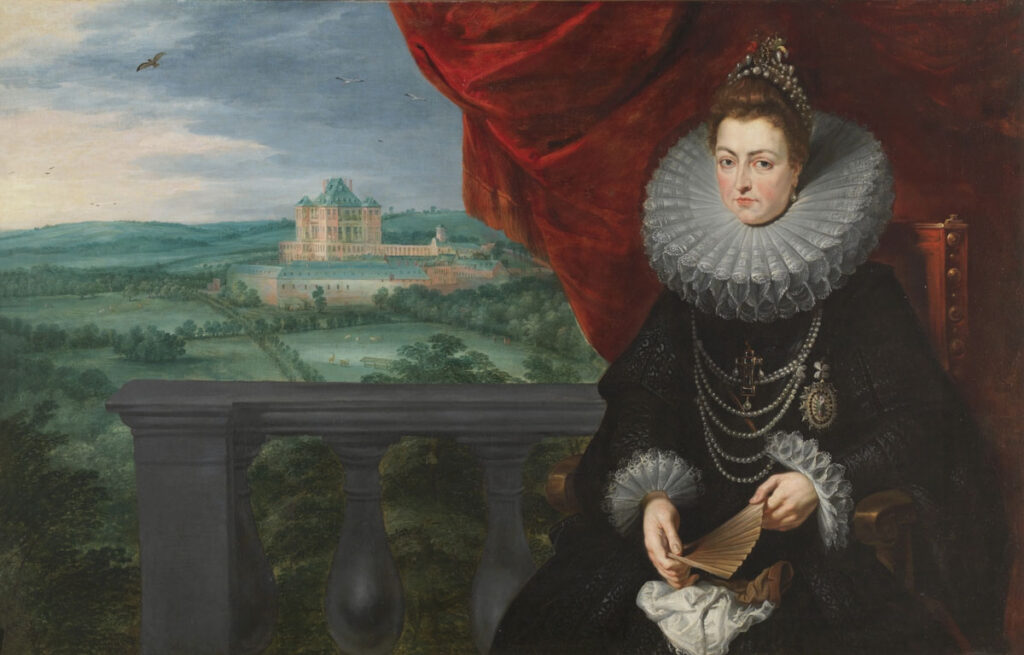
From at least 1611 onwards, court artists, in particular Jan I Breughel, were commissioned to paint views of Mariemont in various formats, from tiny cabinet pictures on copper (Figure 2 above) to enormous canvases nearly three meters wide (Figure 4). They invariably included figures of the archdukes and courtiers, sometimes on a hunt, and other times taking a stroll through the forests. These objects were sent out to foreign courts to demonstrate the prosperity and good governance of the archdukes’ rule, and to anchor that rule in the land itself, and their ancestral rights to its dominion. The castle of Mariemont became emblematic, appearing in the famous Five Senses paintings by Breughel and Rubens (Figure 5), and especially symbolic of Isabel’s sovereignty, featured in the background of perhaps her most famous portrait (Figure 6).
In this context, Breughel and de Momper’s The Infanta Isabel Clara Eugenia in the Park at Mariemontis unusual. Not only is the castle nowhere to be found in the picture, but our view of the landscape is blocked by a bank of trees, forcing us to look down underneath their canopy. The two dozen deer on the right side of the painting show that Mariemont’s park is teeming with game, pointing towards the violent hunts that Isabel so enjoyed, but the animals act as though they have never known any threat. It is an idyllic scene that could never have occurred in reality. Instead, it recalls contemporary paintings of the Garden of Eden, where all creatures lived in harmony before the Fall. This association is strengthened by the central position of the spring, which resonates with the rivers of Eden and biblical references to the ‘water of life’ (John 4:14, Revelation 22:1-2, and others).
In addition, as noted above, the picture is almost wholly populated by women and girls; the exceptions are Albert and a few male servants in the background. Perhaps we are meant to understand that Isabel has been summering at Mariemont with her ladies, while Albert has just stopped in for a visit. In any case, the park is presented as very much Isabel’s space. She is leading the group, and she has created this peaceful paradise. The terraces hidden within the grove demonstrate her mastery over the landscape; Isabel has both cultivated and tamed its natural bounty. Her green dress even blends into the botanical hues that surround her and underscore the land’s fertility. Although Isabel was herself never able to produce that longed-for heir, she is surrounded by children, standing as a kind of Caritas figure and a mother to her adoptive country of the Netherlands.
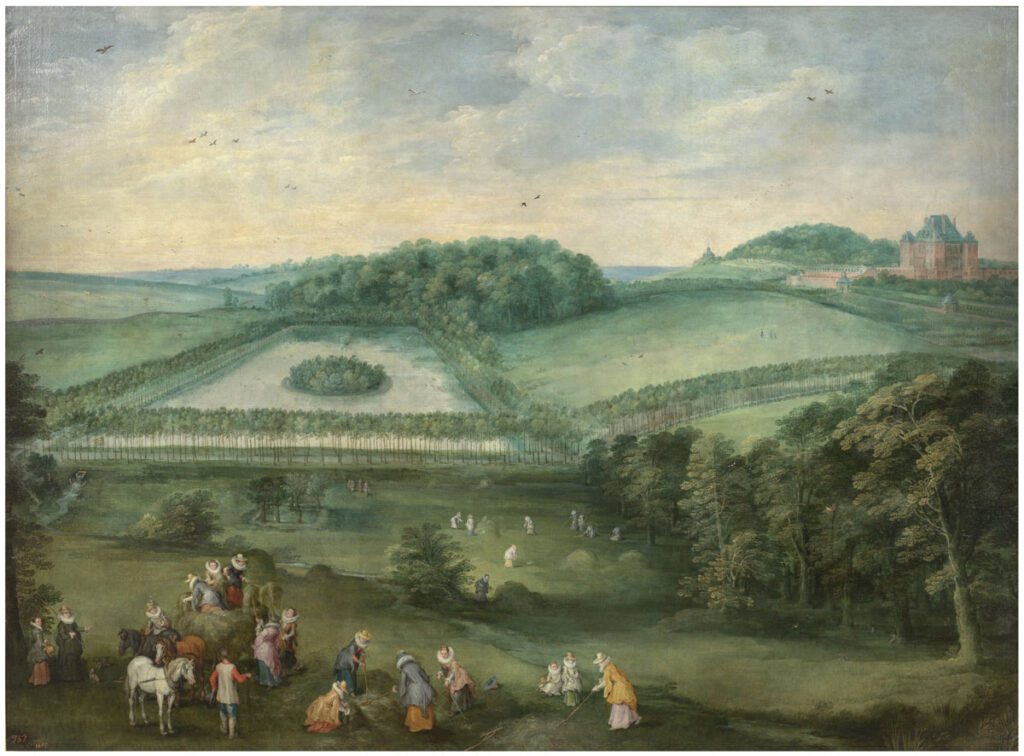
The earliest documentation for The Infanta Isabel Clara Eugenia in the Park at Mariemont is a 1636 inventory of the Torre de la Reina in the Alcázar palace, where it was among twenty-five paintings “brought from Flanders to the Queen (Isabel de Borbón, wife of Philip IV)” that hung in the antechamber to her bedroom.[2] Also among this group was another work in the Prado’s collection, Isabel Clara Eugenia on a Visit to the Countryside (Figure 7), which is of almost the exact same dimensions and must be seen as a pendant. That picture shows the archduchess and her ladies piling cut hay onto a cart, playing at being peasants, in a scene that similarly links Isabel’s governance to a controlled and abundant nature. Isabel Clara Eugenia may have commissioned these two pictures specifically as gifts for Isabel de Borbón, meant to deepen their connection and to convey a vision of tranquil, beneficent female rule from afar.
Selected Bibliography:
- Bernardo J. García García, «The Cross-Influences in Architectural Patronage between Spain and the Low Countries as Revealed in the Letters of Infanta Isabel Clara Eugenia (1598-1621).» In The Low Countries at the Crossroads: Netherlandish Architecture as an Export Product in Early Modern Europe (1480-1680), edited by Konrad Ottenheym and Krista De Jonge (Turnhout: Brepols, 2013), pp. 177–194.
- Mª Cruz de Carlos Varona, «Representando a la reina. La imagen de las Habsburgo españolas en su contexto europeo.» In “Representar la reginalidad en la Europa del siglo XVII. Imágenes, discurso, identidades,” ed. Alejandra Franganillo and Peter Cherry. Special issue, Libros de la corte, 28 (2024), pp. 269–276. https://revistas.uam.es/librosdelacorte/article/view/19700
- José Eloy Hortal Muñoz, «A Key Tool for a New Dynasty: The Use of Royal Sites in the Habsburg Netherlands by the Archdukes Albert and Isabella.» The Court Historian 23, no. 1 (2018), pp. 13–26.
- Marcel De Maeyer, Albrecht en Isabella en de Schilderkunst (Brussels: Paleis der Academiën, 1955).
- Marie De Villermont, L’infante Isabelle, gouvernante des Pays-Bas. 2 vols (Tamines: Duculot-Roulin, 1912).
- Gloria Martínez Leiva and Ángel Rodríguez Rebollo, Quadros y otras cosas que tienen su Magestad Felipe IV en este Alcázar de Madrid: año de 1636 (Madrid: Fundación Universitaria Española, Seminario de Arte e Iconografía «Marqués de Lozoya,» 2007).
- Robert Wellens, «Le domaine de Mariemont au XVIe siècle (1546-1598).» Annales de la Société royale d’archéologie de Bruxelles 50 (1961), pp. 241–247.
- Cordula van Wyhe, ed. Isabel Clara Eugenia: Female Sovereignty in the Courts of Madrid and Brussels (Madrid: Centro de Estudios Europa Hispánica; London, Paul Holberton, 2011).
Captions to works referred to in the text:
- Figure 1. Jan I Breughel and Joos II de Momper, The Infanta Isabel Clara Eugenia in the Park at Mariemont, 1617-1621, oil on canvas, 176 x 236 cm. Madrid, Prado.
- Figure 2. Jan I Breughel, The Archdukes Albert and Isabel before the Castle of Mariemont, 1611, oil on copper, 9.5 x 14.8 cm. Munich, Alte Pinakothek.
- Figure 3. J. M. Cels, View of the Castle of Mariemont, 1844, engraving after a painting of c. 1620 or later. Mariemont, Musée de Mariemont.
- Figure 4. Jan I Breughel, View of Mariemont, 1612, oil on canvas, 186 x 292 cm. Dijon, Musée des Beaux-Arts de Dijon.
- Figure 5. Jan I Breughel and Peter Paul Rubens, The Sense of Hearing, 1617-1618, oil on panel, 64 x 109.5 cm. Madrid, Prado.
- Figure 6. Peter Paul Rubens, The Infanta Isabel Clara Eugenia, c. 1615, oil on canvas, 113 x 175.8 cm. Madrid, Prado.
- Figure 7. Jan I Breughel and Joos II de Momper, Isabel Clara Eugenia on a Visit to the Countryside, c. 1617-1621, oil on canvas, 176 x 238 cm. Madrid, Prado.
[1] De Villermont, 62-63.
[2] See Martínez Leiva and Rodríguez Rebollo.