AGENART
Pieza del mes: Septiembre 2024
Autora invitada: Patricia Manzano Rodríguez
Cómo citar este artículo/How to cite this article: Patricia Manzano Rodríguez, “The Princess in Mourning: Margarita of Austria’s Last Spanish Portrait”, Agenart: La agencia artística de las mujeres de la Casa de Austria, 1532-1700, 01 de septiembre de 2024. Consultado: 28 de julio de 2026. URL: https://agenart.org/the-princess-in-mourning-margarita-of-austrias-last-spanish-portrait/
Margarita Teresa of Austria (1651–1673), daughter of Philip IV of Spain and Mariana of Austria, is most famously depicted in Diego Velázquez’s iconic painting, Las Meninas (Museo del Prado, 1656). Forever frozen as a playful child in a white dress, Margarita would later become central to the political alliances of European royalty, particularly through her marriage to her uncle, Emperor Leopold I of Austria, on December 12, 1666. This marriage was a strategic move designed to consolidate Habsburg influence across Europe, and Margarita herself became a symbol of continuity within both branches of the powerful Habsburg dynasty.
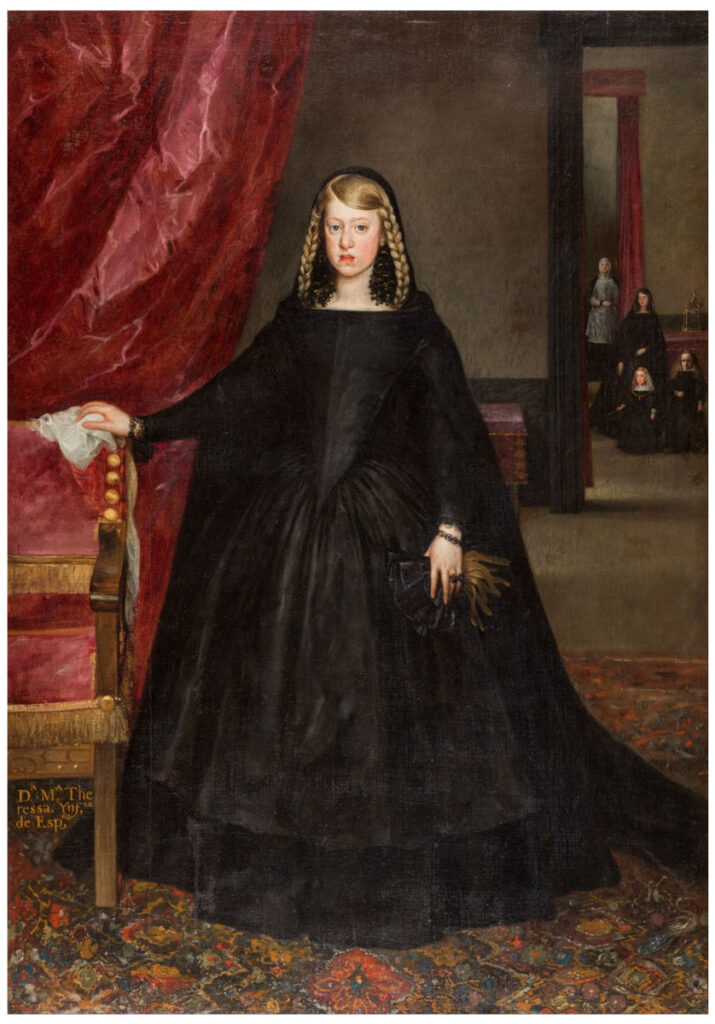
This portrait of Margarita (Figure 1) offers deep insight into the circumstances surrounding her departure from Spain. The painting was created by Juan Bautista Martínez del Mazo (ca. 1611–1667), who was Velázquez’s son-in-law and artistic successor. Historiography has frequently neglected Mazo, who has been overshadowed by his father-in-law, but who acquired great fame and recognition in the seventeenth century as a copyist and portraitist. Mazo was appointed pintor de cámara after the death of Velázquez in 1660, and his style became so close to Velázquez’s that the attribution of some of their works is still disputed. Thus, this painting embodies the traditions of Spanish court portraiture, heavily influenced by the style and techniques of Velázquez.
In this work, Margarita (mistakenly labeled as her half-sister María Teresa in a later inscription), is shown in a black mourning dress, a choice of attire that situates the creation of the portrait between September 1665, following the death of her father, and December 1666, when she left for Vienna. The mourning dress not only places the portrait within a specific historical context but also imbues the image with a sense of gravity and introspection. This dual purpose of the portrait, as both a commemorative piece and a formal representation, reflects Margarita’s transition as she prepared for her new role in the Austrian court. In the painting, Margarita stands inside the Alcázar of Madrid. She is in full-length, gazing directly at the viewer. Her right hand reaches towards an empty chair covered in rich red fabric, with a handkerchief preventing direct contact with the seat, itself a reference to the throne her father had left vacant. In her left hand, she holds a pair of gloves. Behind her, a red curtain frames the left side of the painting, a common feature in court portraits as a symbol of royal status. The meticulous rendering of the curtain and the elaborate patterns of the rug beneath her feet showcase Mazo’s skill in depicting luxurious textures and significant details in the ‘blotchy’ and sketch-like manner characteristic of Velázquez.
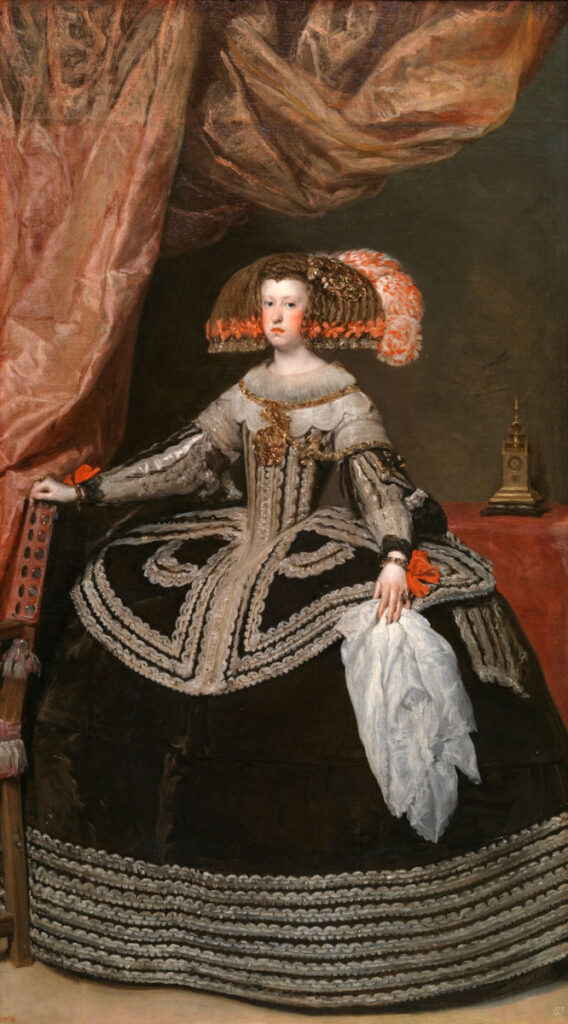
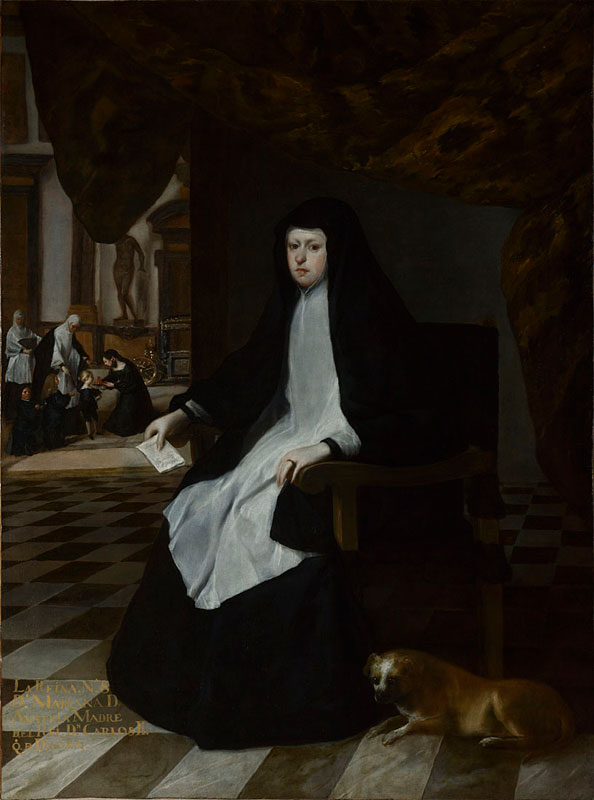
One of the most compelling aspects of this portrait of Margarita is the depiction of a secondary space visible through an open doorway in the background. Here, several figures dressed in black are gathered, adding narrative depth to the composition. A table clock, positioned subtly in the background among these figures, reinforces Margarita’s royal status and creates a visual connection to the first portraits of her mother in the Spanish court (Figure 2). Within this group we find a young Charles II, Margarita’s brother and the newly crowned King of Spain. He is shown holding a sceptre and wearing the emblem of the Order of the Golden Fleece, which is prominently displayed on his chest. Accompanying Charles II are two attendants, one of whom is believed to be Mari Bárbola, also seen in the foreground of Las Meninas. A woman dressed in the traditional mourning attire of a noble widow stands further back; she is perhaps Queen Mariana. Her presence could underscore her new political role as Queen Regent after the death of Philip IV, although this identification remains uncertain. Mazo employed this compositional approach—including background scenes with Charles II as protagonist—in other works to highlight the continuity of the Habsburg lineage. Similar scenes can be glimpsed in the portraits of Mariana in mourning (Figure 3), of which at least three autograph versions exist. These portraits of queens and princesses, then, go beyond mere representations of the sitter to convey complex messages about power and dynastic succession.
This particular painting of Margarita in mourning may have been intended for display in the Quadra de Mediodía at El Escorial, a space that Mazo likely redecorated after Velázquez’s death left the project unfinished. Through portraiture, the room promoted the Habsburg image of authority and dynastic continuity with individual representations of the royal family, displaying the likeness of Philip IV in Armour, with a Lion at his Feet by Velázquez and his workshop (Museo del Prado, ca. 1653), Velázquez’s Queen Mariana of Austria (Figure 2), and a lost representation of Charles II. The picture of the infanta in mourning was likely the last portrait of Margarita produced in Madrid, and it serves as a poignant farewell to a princess who would soon leave Spain to assume her role as Empress of Austria.
Selected bibliography:
- Juan Allende-Salazar and Francisco Javier Sánchez Cantón, Retratos del Museo del Prado: identificación y rectificaciones (Madrid: Julio Casano, 1919).
- Nina Ayala Mallory, “Juan Bautista Martínez del Mazo, retratos y paisajes,” Goya: revista de arte, no. 221 (1991): pp. 265–76.
- Bonaventura Bassegoda i Hugas, El Escorial como museo: la decoración pictórica mueble en el Monasterio de El Escorial desde Diego Velázquez hasta Frédéric Quilliet (1809) (Barcelona: Universitat Autònoma de Barcelona, 2002).
- Carmen Bernis, “El traje de viudas y dueñas en los cuadros de Velázquez y su escuela,” in Miscelánea de arte (Madrid: Consejo Superior de Investigaciones Científicas, 1982), pp. 145–54.
- María del Mar Doval Trueba, “Sobre algunos retratos ‘velazqueños’ de la Infanta Margarita,” Goya: Revista de arte, no. 313–314 (2006): pp. 245–50.
- Rocío Martínez López, “‘La infanta se ha de casar con quien facilite la paz o disponga los medios para la guerra’. Las negociaciones para la realización del matrimonio entre la infanta María Teresa y Leopoldo I (1654-1657),” Revista de Historia Moderna: Anales de la Universidad de Alicante, no. 33 (2015): pp. 79–99.
- Álvaro Pascual Chenel, El retrato de Estado durante el reinado de Carlos II. Imagen y propaganda (Madrid: Fundación Universitaria Española, 2010).
- Javier Portús Pérez, ed., Velázquez. “Las Meninas” and the Late Royal Portraits (London: Thames and Hudson, 2014).
- Marina Sánchez Montero, “Indumentaria y traslación geográfica de la viudedad,” Agenart: La agencia artística de las mujeres de la Casa de Austria, 1532-1700, 08 de enero de 2024. Consultado: 23 de agosto de 2024. URL: https://agenart.org/indumentaria-y-traslacion-geografica-de-la-viudedad/
Captions to works referred to in the text:
- Figure 1. Juan Bautista Martínez del Mazo, Margarita de Austria, 1665–66, oil on canvas, 205 × 144 cm, Museo Nacional del Prado, Madrid.
- Figure 2. Diego Rodríguez de Silva y Velázquez, Queen Mariana of Austria, 1652–53, oil on canvas, 234 × 132 cm, Museo Nacional del Prado, Madrid.
- Figure 3. Juan Bautista Martínez del Mazo, Queen Mariana of Spain in Mourning, 1666, oil on canvas, 197 × 146 cm, National Gallery, London.